The Clockwork Penguin

Daniel Binns is a media theorist and filmmaker tinkering with the weird edges of technology, storytelling, and screen culture. He is the author of Material Media-Making in the Digital Age and currently writes about posthuman poetics, glitchy machines, and speculative media worlds.

Category: Conferences

  • Against the totalising imaginary

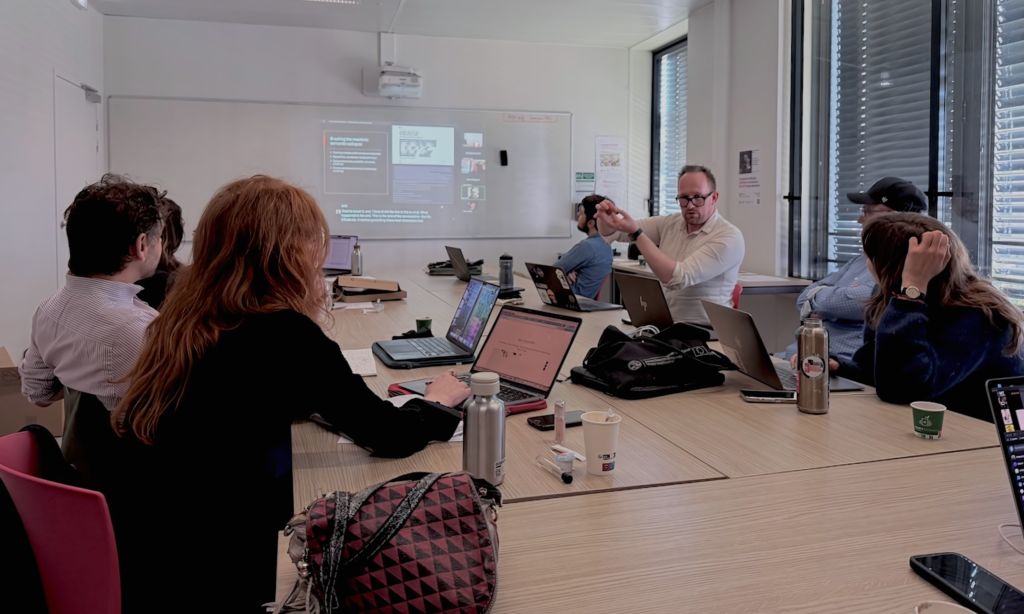
    Dans le vif: Presenting at Campus Condorcet, Friday 24 April 2026.

    My sabbatical in France has continued apace, with plenty of fruitful meetings and discussions, and not a little writing (deadlines sadly declined a similar holiday).

    On 24 April, I had the opportunity to present some of my research at Université Paris 8-Vincennes-Saint Denis — a university founded by figures including Jacques Derrida, Hélène Cixous, and Roland Barthes in the aftermath of May ’68.

    I presented a talk titled “Against the Totalising Imaginary: Weird AI and the Ecology of the Possible”, in which I discussed my glitch-based experiments and methodologies, which I refer to as ‘ritual-technics’. For the first time, I also proposed worldbuilding and storytelling as productive frameworks for engaging with technologies like generative AI.

    I began with the Slopocene. This has been bandied about as a pejorative term for our current overload of synthetic content and governance by algorithm, with the resulting crises of authenticity, ‘reality’, and authorship. As in other work, I’m working to reclaim the Slopocene as a productive and playful term, but also as a speculative near-future or alt-present, where recursive training collapse turns the web into a haunted archive of confused bots, discarded memes, and broken truths.

    How to navigate the Slopocene? I co-opted the work of my co-presenters for the seminar: Boris Eldagsen, Rosa Cinelli, and Philippe Boisnard, alongside Chris Chesher and Cesar Albarran-Torres, Eryk Salvaggio, and Ian Haig. These are diverse approaches, but they have a few common clusters: material/semiotic, i.e. we can read AI outputs diagnostically as results of training data; relationality/phemomenology, in terms of what kind of encounter or interaction we have with AI technology; and then an aesthetic/resistant thread, which finds value in the visual breakdown and visceral sensation of encountering AI media.

    These are methods, approaches, attitudes that resist zealous techno-utopia or simplistic and naive dystopic rejection, preferring instead to pay close attention to generative AI’s computational and cultural mechanisms. Essentially these are all ways to ‘stay with’ the machine.

    My own approach weaves a thread through the material/semiotic, the relational/phenomenological, and the aesthetic/resistant — an approach I refer to formally as critical-creative AI, or informally: gonzo AI. The approach is the practical/experimental arm of my broader media-materialist approach, where I position myself as a tinkerer-theorist, which translates beautifully in French to bricoleur-théoricien.

    I went through a few of my experiments with genAI, including semantic collapse, music generation, before introducing The Drift, my worldbuilding project where all my weird AI creations live. The Drift is “a space to think and to play and to build, and an alternative imaginary to the totalising mythology that Big Technology would love us to believe, where AI is everything and everything has to be AI”:

    “It’s a world where messiness is the point, where you can be a critical observer but also someone who lives in the space as an inhabitant. There are lovely tensions between delight and disturbance, being critical and being caught-up-in-it — living in these tensions is the only honest position you can have. Games and world-building and storytelling are forms where you can hold the contradiction, you can live with the tension. And it’s a feature of these media rather than a bug or an error.”
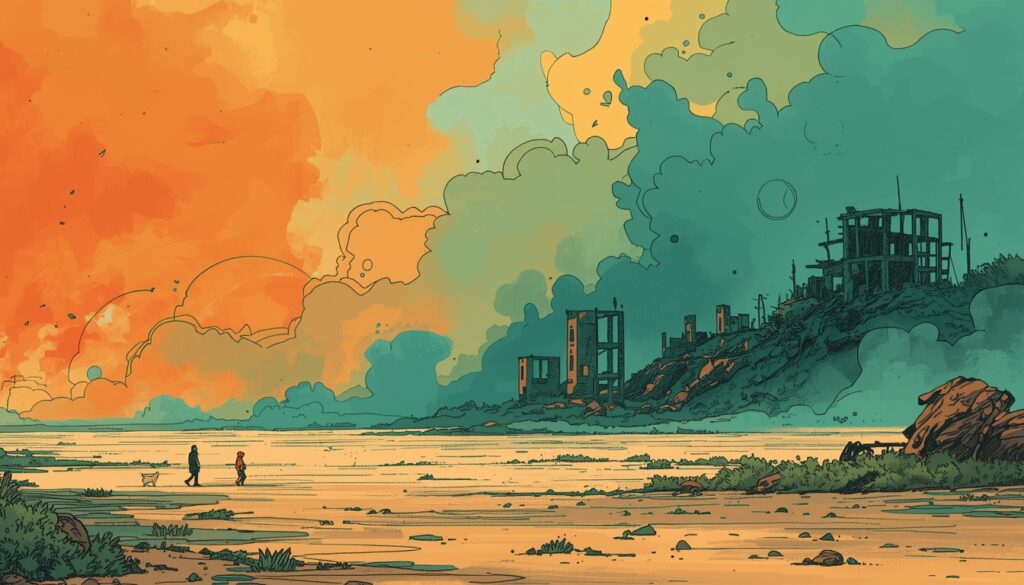
    Image generated by Leonardo.Ai, 20 April 2026; prompt by me.

    This HERMES Seminaire, titled “Imaginaires artificiels : créativité et recherche à l’ère de l’image générative”, featured co-presenters Boris Eldagsen, Rosa Cinelli, and philippe boisnard, who shared their innovative approaches to exploring and deconstructing large language models and media generators.

    Université Paris 8 has been my host throughout this research trip, and it already feels like home. The institution embraces a diversity of experience among students and faculty, with interdisciplinary research and creative methods as the norm. Special thanks to Everardo Reyes of Laboratoire Paragraphe, who has been a generous friend and co-conspirator over the past couple of years.

  • From Caméra-Stylo to Prompt-Stylo

    A few weeks ago I was invited to present some of my work at Caméra-Stylo, a fantastic conference run every two years by the Sydney Literature and Cinema Network.

    For this presentation, I wanted to start to formalise the experimental approach I’d been employing around generative AI, and to give it some theoretical grounding. I wasn’t entirely surprised to find that only by looking back at my old notes on early film theory would I unearth the perfect words, terms, and ideas to, ahem, frame my work.

    Here’s a recording of the talk:

    Let me know what you think, and do contact me if you want to chat more or use some of this work yourself.

  • Come sail away

    It’s been over a year since I worked on the weekend. Since some pretty severe burnout I’ve had to make sure that weekends and most weeknights are kept free, though sometimes the latter is unavoidable.

    But this weekend, between a full and crazy week last week, and an equally insane three days from tomorrow (Monday), I literally ran out of time to get everything done.

    I would now never advocate for weekend work, but occasionally – very occasionally – the grind can have its satisfactions. Particularly if it’s a typically grey and awful Melbourne day outside.

    The task I ran out of time to complete was a paper I’m delivering at a symposium tomorrow. To be fair, I think I’d be forgiven for running out of time, given I organised the symposium, but I really did want something semi-decent to present.

    I’ve basically kicked off conference season myself; after this talk, I have another 2-3 to prepare for late November/early December. But I think I’m being strategic here: with 4ish papers done, I can then work to convert one or two into full articles/chapters next year.

    The RMS Publish or Perish sails on…

  • Inhuman Screens

    40007774_10156060429249086_3856612823417225216_o.jpg

    I am thrilled to announce that I’ve been invited to present at the inaugural Inhuman Screens conference, convened in conjunction with Sydney Underground Film Festival.

    I’ll be presenting my research on drones and cinematography. This work considers the embodied experience of flying a drone, and some of the philosophical/existential questions that experience raises, as well as how drone shots might be brought into the language of film distinctly from other aerial footage.

    All speakers, keynotes and primary stream, comprise many of my film theory faves, so I look forward mostly to getting my presentation over and done with, and simply basking in the awesome to follow.

    Tickets available at the Inhuman Screens website.

  • Yes we POPCAANZ

    Lambton Harbour and Oriental Bay as seen from the summit of Mount Victoria (pic by me).
    Lambton Harbour and Oriental Bay as seen from the summit of Mount Victoria (pic by me).

    I’m sitting in an apartment, outside which the manic Wellington weather swirls and swishes. After a glorious week, with crisp, sunny days (see above), the clouds have rolled in, and it’s bucketing down.

    However, today’s disposition is not dampening mine, with the memories of a second, successful POPCAANZ fresh in my mind. My paper on the cinematic frame was received well, with lots of excitement that I’m developing more research and teaching on the same topic. But that was out of the way early on, and I was able to settle in and see a bunch of other, vastly more intelligent people talk about their passions.

    There was a Baudrillardian deconstruction of Wes Anderson which was so thorough that by the end he did not exist. Another highlight was a refiguring of the narrative of Toy Story according to an object-oriented ontology, and a materiality of trash. Not to mention a textual analysis of Agony Aunt columns in the New Zealand Women’s Weekly. And then an introduction to the Leathermen culture of rural New Zealand.

    And that’s barely scratching the surface (and I only mentioned two papers in a very strong film stream). Food was great, the location (Massey University) very cosy and accommodating, and the company a lively combination of old friends and new contacts.

    There was very exciting news, too, that POPCAANZ will now be opening up to our Asian neighbours, and revamping the associated journal accordingly.

    Bring on Sydney next year!