The Clockwork Penguin

Daniel Binns is a media theorist and filmmaker tinkering with the weird edges of technology, storytelling, and screen culture. He is the author of Material Media-Making in the Digital Age and currently writes about posthuman poetics, glitchy machines, and speculative media worlds.

Tag: algorithmic media

  • Like No One Is Watching

    Title slide of my paper “Like No One Is Watching”.

    I’ve kicked off a month’s research sabbatical in France, hitting the ground running…

    My first invited presentation was today at Université Paris I: Panthéon-Sorbonne, as part of the journée d’étude “L’intelligence et l’éthique de la télévision à l’ère des algorithms”. Today’s talks looked at de-ageing as a quest for immortality and fracturing of the present, televisuality and intelligence, and teaching LLMs about humans by making them watch a lot of TV; the seminar concludes tomorrow.

    My own piece, “Like No One Is Watching: The Form of Television in the Algorithmic Moment”, examined how episodic storytelling navigates the constraints of the platform and attention economies. I looked at the chaotic inconsistency of The Bear and the aggressive tedium of The Pitt as shows pushing formal boundaries to reassert a direct relationship with their audience.

    The talk had three key moves.

    Firstly, I re-establish television as the ‘miscreant medium’, drawing from John Fiske and John Hartley’s seminal work. On the one hand, television has always served as a scapegoat or delivery channel for whatever moral panic is current at the time; alongside this, it is a medium perennially torn between the strictures of institutions and technology, and the creativity of its artists.

    Secondly, I argue that platform logic holds two contradictory assumptions about audiences. On one hand, there is an assumption that audiences are passive and distracted. This assumption leads to baked-in redundancies, including explicit exposition and constant re-explanation (a phenomenon that Will Tavlin explores in his piece ‘Casual Viewing’). On the other hand, platform capitalism is contingent on metrics of retention; active, engaged viewing, then, is assumed.

    In the third section, I spoke to sample clips from The Bear and The Pitt, both shows that embody and embrace this presumptive schizophrenia. From The Bear I played part of the seventh episode of the first season, which includes a 17-minute unbroken take. I also shared a couple of mundane conversation scenes from the premiere episode of The Pitt. I used formal analysis here as a diagnostic tool, to observe how creatives push against (or acquiesce to) the algorithmic frame of their distribution. In the case of both shows, I offered that formal experimentation — whether at a dialogue, scene, episode, or series level — demonstrates friction as an exercise in meaning-making: a conversation and negotiation between creator and audience quite apart from questions of data, platform, capital.

    What close formal analysis reveals is that television is not a medium in decline, but one still jovially misbehaving; always exceeding what the discourse says it’s capable of, and still worth watching.

    This talk was a return to formal analysis for me, and it felt great to be home. I’ve been very lucky to be taught by or to work with a bunch of academics who really value close textual analysis, and I think it’s such an incisive and enjoyable means of understanding texts and their contexts.

    It’s highly likely an edited collection will result from this gathering, so fingers crossed that this work will be in print soon!
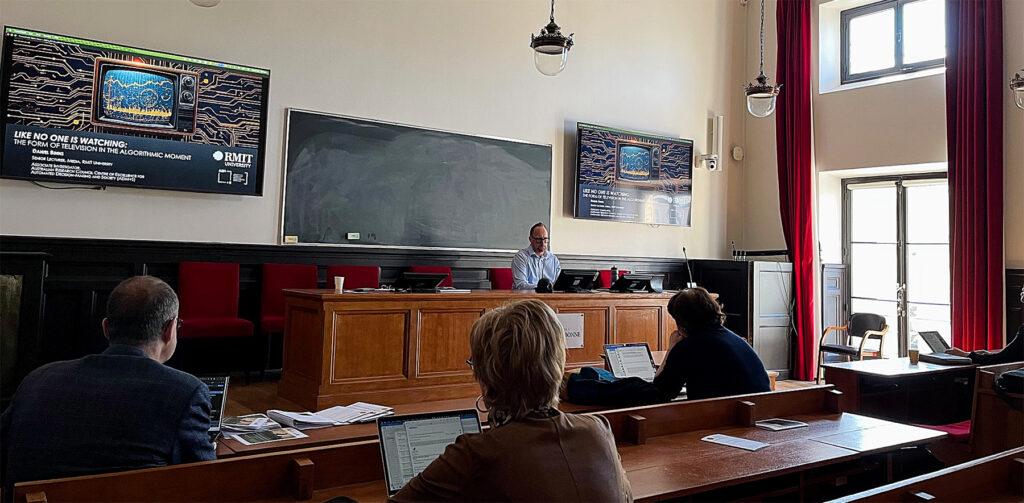
    Giving my talk at Université Paris 1-Panthéon Sorbonne. Photo thanks to Sandra Laugier.

    I now have a little breathing room before my second presentation, so I’ll be using this time to actually get out and wander around Paris a little, but also to feed and tend to a few items moving through the publication pipeline.

  • Shift Lock #3: A sales pitch for the tepid take

    After ‘abandoning’ the blog part of this site in early 2022, I embarked on a foolish newsletter endeavour called Shift Lock. It was fun and/or sustainable for a handful of posts, but then life got in the way. Over the next little while I’ll re-post those ruminations here for posterity. Errors and omissions my own. This instalment was published May 5, 2022 (see all Shift Lock posts here).


    Photo by Pixabay on Pexels.com

    Twitter was already a corporate entity, and had been struggling with how to market and position itself anyway. Not to mention, its free speech woes — irrevocably tied to those of its competitors — are not surprising. If anything, Mr. Musk was something of a golden ticket: someone to hand everything over to.

    The influx/exodus cycle started before the news was official… Muskovites joined/returned to Twitter in droves, opponents found scrolls bearing ancient Mastodon tutorials and set up their own mini-networks (let’s leave that irony steaming in the corner for now).

    None of this is new: businesses are bought and sold all the time, the right to free speech is never unconditional (and nor should it be), and the general populace move and shift and migrate betwixt different services, platforms, apps, and spaces all the time.

    What seems new, or at least different, about these latter media trends, issues, events, is the sheer volume of coverage they receive. What tends to happen with news from media industries (be they creative, social, or otherwise) is wall-to-wall coverage for a given week or two, before things peter out and we move on to the next block. It seems that online culture operates at two speeds: an instantaneous, rolling, roiling stream of chaos; and a broader, slightly slower rise and fall, where you can actually see trends come and go across a given time period. Taking the Oscars slap as an example: maybe that rise and fall lasts a week. Sometimes it might last two to four, as in the case of Musk and Twitter.

    How, then, do we consider or position these two speeds in broader ‘culture’?

    Like all of the aforementioned, Trump was not a new phenomenon. Populism was a tried and tested political strategy in 2015-16; just, admittedly, a strategy that many of us hoped had faded into obsolescence. However, true to the 20-30 year cycle of such things, Trump emerged. And while his wings were — mostly — clipped by the checks and balances of the over-complex American political system, the real legacy of his reign is our current post-truth moment. And that legacy is exemplified by a classic communications strategy: jamming. Jam the airwaves for a week, so everyone is talking about only one thing. Distract everyone from deeper issues that need work.

    This jamming doesn’t necessary come from politicians, from strategists, from agencies, as it may once have done. Rather, it comes from a conversational consensus emerging from platforms — and this consensus is most likely algorithmically-driven. That’s the real concern. And as much as Musk may want to open up the doors and release the code, it’s really not that straightforward.

    The algorithms behind social media platforms are complex — more than that, they are nested, like a kind of digital Rube Goldberg machine. People working on one section of the code are not aware nor comprehending of what other teams might be working on, beyond any do-not-disturb-type directives from on high. As scholar Nick Seaver says in a recent Washington Post piece, “The people inside Twitter want to understand how their algorithm works, too.” (Albergotti 2022)

    Algorithms — at least those employed by companies like Twitter — are built to stoke the fires of engagement. And there ain’t no gasoline like reactions, like outrage, like whatever the ‘big thing’ is for that particular week. These wildfires also intersect with the broader culture in ways that it takes longer-form criticism (I would say academic scholarship, but we often miss the mark, or more accurately, due to glacial peer review turnarounds, the boat) to meaningfully engage and understand.

    Thanks partly to COVID but also to general mental health stuff, I’ve been on a weird journey with social media (and news, to be fair) over the past 3-5 years. Occasional sabbaticals have certainly helped, but increasingly I’m just not checking it. This year I’ve found more and more writers and commentators whose long-form work I appreciate as a way of keeping across things, but also just for slightly more measured takes. Tepid takes. Not like a spa but more like a heated pool. This is partly why I started this newsletter-based journey, just to let myself think things through in a way that didn’t need to be posted immediately, but nor did I need to wait months/years for peer review. Somewhere beyond even the second trend-based speed I mentioned above.

    What it really lets me do, though, is disengage from the constant flow of algorithmically-driven media, opinion, reaction, and so on, in a way where I can still do that thinking in a relevant and appropriate way. What I’m hoping is that this kind of distance lets me turn around and observe that flow in new and interesting ways.


    Below the divider

    At the end of each post I link a few sites, posts, articles, videos that have piqued my interest of late. Some are connected to my research, some to teaching and other parts of academia, still others are… significantly less so (let’s keep some fun going, shall we?).


    Reed Albergotti (2022, 16 April), ‘Elon Musk wants Twitter’s algorithm to be public. It’s not that simple.’ Washington Post.