I’ve kicked off a month’s research sabbatical in France, hitting the ground running…
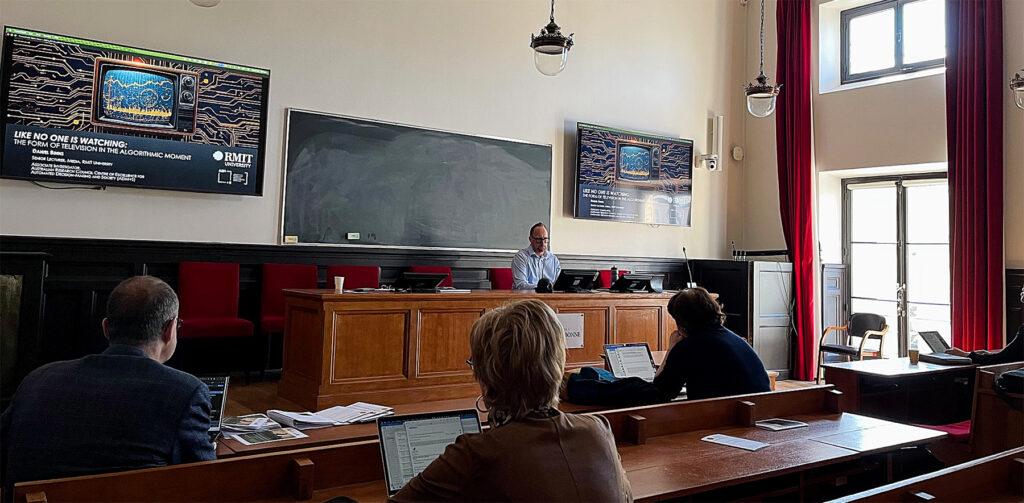
My first invited presentation was today at Université Paris I: Panthéon-Sorbonne, as part of the journée d’étude “L’intelligence et l’éthique de la télévision à l’ère des algorithms”. Today’s talks looked at de-ageing as a quest for immortality and fracturing of the present, televisuality and intelligence, and teaching LLMs about humans by making them watch a lot of TV; the seminar concludes tomorrow.
My own piece, “Like No One Is Watching: The Form of Television in the Algorithmic Moment”, examined how episodic storytelling navigates the constraints of the platform and attention economies. I looked at the chaotic inconsistency of The Bear and the aggressive tedium of The Pitt as shows pushing formal boundaries to reassert a direct relationship with their audience.
The talk had three key moves.
Firstly, I re-establish television as the ‘miscreant medium’, drawing from John Fiske and John Hartley’s seminal work. On the one hand, television has always served as a scapegoat or delivery channel for whatever moral panic is current at the time; alongside this, it is a medium perennially torn between the strictures of institutions and technology, and the creativity of its artists.
Secondly, I argue that platform logic holds two contradictory assumptions about audiences. On one hand, there is an assumption that audiences are passive and distracted. This assumption leads to baked-in redundancies, including explicit exposition and constant re-explanation (a phenomenon that Will Tavlin explores in his piece ‘Casual Viewing’). On the other hand, platform capitalism is contingent on metrics of retention; active, engaged viewing, then, is assumed.
In the third section, I spoke to sample clips from The Bear and The Pitt, both shows that embody and embrace this presumptive schizophrenia. From The Bear I played part of the seventh episode of the first season, which includes a 17-minute unbroken take. I also shared a couple of mundane conversation scenes from the premiere episode of The Pitt. I used formal analysis here as a diagnostic tool, to observe how creatives push against (or acquiesce to) the algorithmic frame of their distribution. In the case of both shows, I offered that formal experimentation — whether at a dialogue, scene, episode, or series level — demonstrates friction as an exercise in meaning-making: a conversation and negotiation between creator and audience quite apart from questions of data, platform, capital.
What close formal analysis reveals is that television is not a medium in decline, but one still jovially misbehaving; always exceeding what the discourse says it’s capable of, and still worth watching.
This talk was a return to formal analysis for me, and it felt great to be home. I’ve been very lucky to be taught by or to work with a bunch of academics who really value close textual analysis, and I think it’s such an incisive and enjoyable means of understanding texts and their contexts.
It’s highly likely an edited collection will result from this gathering, so fingers crossed that this work will be in print soon!
I now have a little breathing room before my second presentation, so I’ll be using this time to actually get out and wander around Paris a little, but also to feed and tend to a few items moving through the publication pipeline.