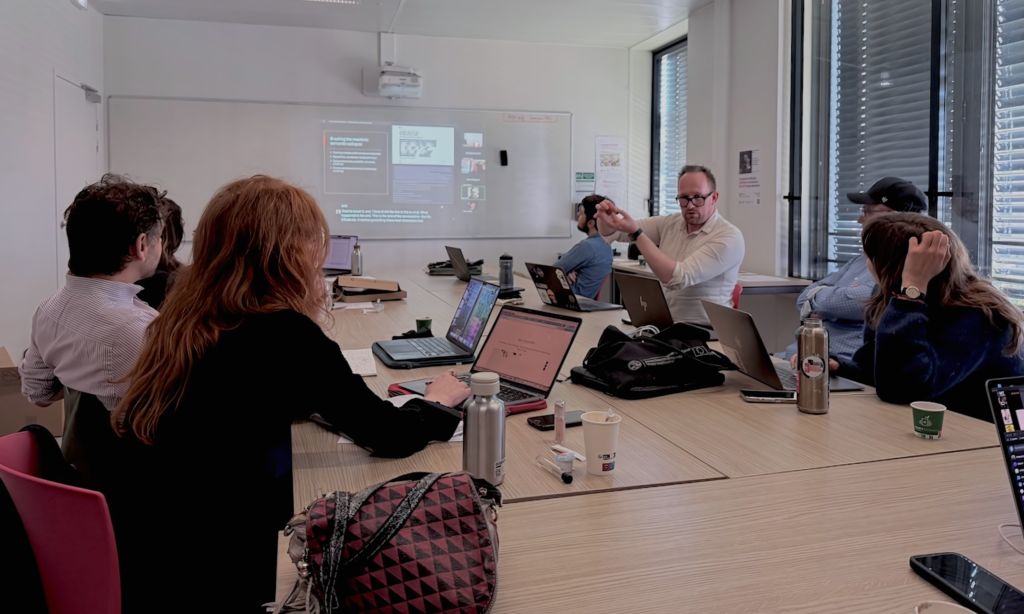
My sabbatical in France has continued apace, with plenty of fruitful meetings and discussions, and not a little writing (deadlines sadly declined a similar holiday).
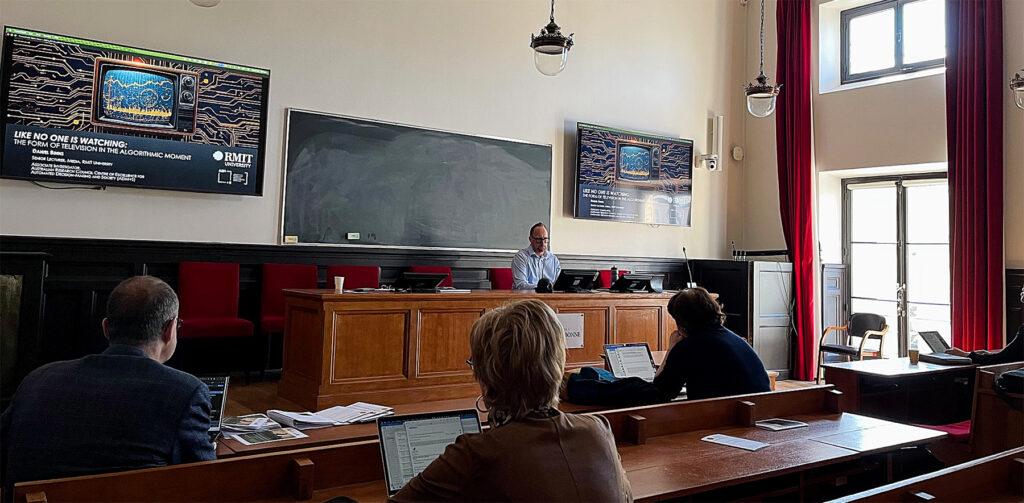
On 24 April, I had the opportunity to present some of my research at Université Paris 8-Vincennes-Saint Denis — a university founded by figures including Jacques Derrida, Hélène Cixous, and Roland Barthes in the aftermath of May ’68.
I presented a talk titled “Against the Totalising Imaginary: Weird AI and the Ecology of the Possible”, in which I discussed my glitch-based experiments and methodologies, which I refer to as ‘ritual-technics’. For the first time, I also proposed worldbuilding and storytelling as productive frameworks for engaging with technologies like generative AI.
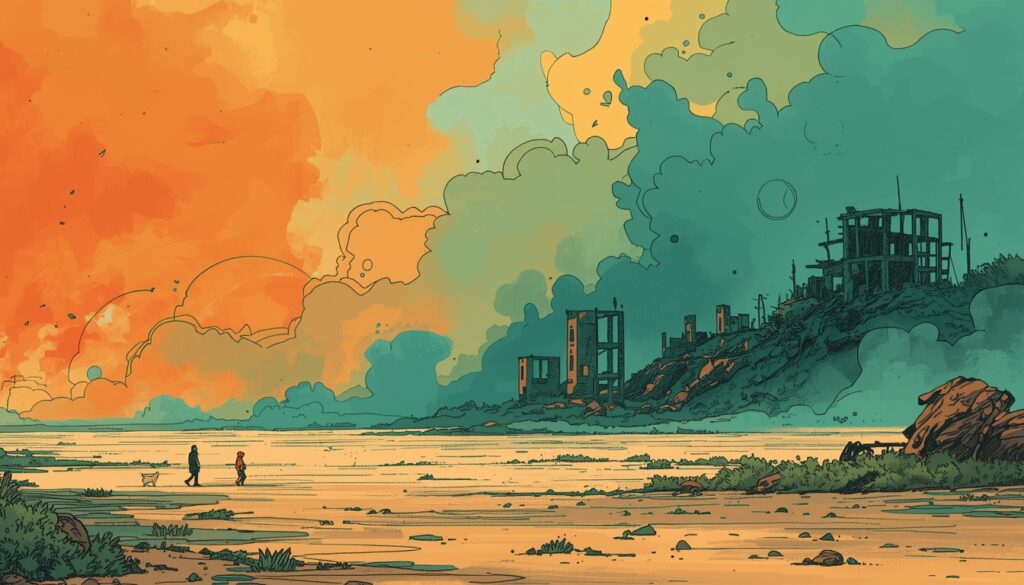
I began with the Slopocene. This has been bandied about as a pejorative term for our current overload of synthetic content and governance by algorithm, with the resulting crises of authenticity, ‘reality’, and authorship. As in other work, I’m working to reclaim the Slopocene as a productive and playful term, but also as a speculative near-future or alt-present, where recursive training collapse turns the web into a haunted archive of confused bots, discarded memes, and broken truths.
How to navigate the Slopocene? I co-opted the work of my co-presenters for the seminar: Boris Eldagsen, Rosa Cinelli, and Philippe Boisnard, alongside Chris Chesher and Cesar Albarran-Torres, Eryk Salvaggio, and Ian Haig. These are diverse approaches, but they have a few common clusters: material/semiotic, i.e. we can read AI outputs diagnostically as results of training data; relationality/phemomenology, in terms of what kind of encounter or interaction we have with AI technology; and then an aesthetic/resistant thread, which finds value in the visual breakdown and visceral sensation of encountering AI media.
These are methods, approaches, attitudes that resist zealous techno-utopia or simplistic and naive dystopic rejection, preferring instead to pay close attention to generative AI’s computational and cultural mechanisms. Essentially these are all ways to ‘stay with’ the machine.
My own approach weaves a thread through the material/semiotic, the relational/phenomenological, and the aesthetic/resistant — an approach I refer to formally as critical-creative AI, or informally: gonzo AI. The approach is the practical/experimental arm of my broader media-materialist approach, where I position myself as a tinkerer-theorist, which translates beautifully in French to bricoleur-théoricien.
I went through a few of my experiments with genAI, including semantic collapse, music generation, before introducing The Drift, my worldbuilding project where all my weird AI creations live. The Drift is “a space to think and to play and to build, and an alternative imaginary to the totalising mythology that Big Technology would love us to believe, where AI is everything and everything has to be AI”:
“It’s a world where messiness is the point, where you can be a critical observer but also someone who lives in the space as an inhabitant. There are lovely tensions between delight and disturbance, being critical and being caught-up-in-it — living in these tensions is the only honest position you can have. Games and world-building and storytelling are forms where you can hold the contradiction, you can live with the tension. And it’s a feature of these media rather than a bug or an error.”
This HERMES Seminaire, titled “Imaginaires artificiels : créativité et recherche à l’ère de l’image générative”, featured co-presenters Boris Eldagsen, Rosa Cinelli, and philippe boisnard, who shared their innovative approaches to exploring and deconstructing large language models and media generators.
Université Paris 8 has been my host throughout this research trip, and it already feels like home. The institution embraces a diversity of experience among students and faculty, with interdisciplinary research and creative methods as the norm. Special thanks to Everardo Reyes of Laboratoire Paragraphe, who has been a generous friend and co-conspirator over the past couple of years.