Daniel Binns is a media theorist and filmmaker tinkering with the weird edges of technology, storytelling, and screen culture. He is the author of Material Media-Making in the Digital Age and currently writes about posthuman poetics, glitchy machines, and speculative media worlds.
Title slide of my paper “Like No One Is Watching”.
I’ve kicked off a month’s research sabbatical in France, hitting the ground running…
My first invited presentation was today at Université Paris I: Panthéon-Sorbonne, as part of the journée d’étude “L’intelligence et l’éthique de la télévision à l’ère des algorithms”. Today’s talks looked at de-ageing as a quest for immortality and fracturing of the present, televisuality and intelligence, and teaching LLMs about humans by making them watch a lot of TV; the seminar concludes tomorrow.
My own piece, “Like No One Is Watching: The Form of Television in the Algorithmic Moment”, examined how episodic storytelling navigates the constraints of the platform and attention economies. I looked at the chaotic inconsistency of The Bear and the aggressive tedium of The Pitt as shows pushing formal boundaries to reassert a direct relationship with their audience.
The talk had three key moves.
Firstly, I re-establish television as the ‘miscreant medium’, drawing from John Fiske and John Hartley’s seminal work. On the one hand, television has always served as a scapegoat or delivery channel for whatever moral panic is current at the time; alongside this, it is a medium perennially torn between the strictures of institutions and technology, and the creativity of its artists.
Secondly, I argue that platform logic holds two contradictory assumptions about audiences. On one hand, there is an assumption that audiences are passive and distracted. This assumption leads to baked-in redundancies, including explicit exposition and constant re-explanation (a phenomenon that Will Tavlin explores in his piece ‘Casual Viewing’). On the other hand, platform capitalism is contingent on metrics of retention; active, engaged viewing, then, is assumed.
In the third section, I spoke to sample clips from The Bear and The Pitt, both shows that embody and embrace this presumptive schizophrenia. From The Bear I played part of the seventh episode of the first season, which includes a 17-minute unbroken take. I also shared a couple of mundane conversation scenes from the premiere episode of The Pitt. I used formal analysis here as a diagnostic tool, to observe how creatives push against (or acquiesce to) the algorithmic frame of their distribution. In the case of both shows, I offered that formal experimentation — whether at a dialogue, scene, episode, or series level — demonstrates friction as an exercise in meaning-making: a conversation and negotiation between creator and audience quite apart from questions of data, platform, capital.
What close formal analysis reveals is that television is not a medium in decline, but one still jovially misbehaving; always exceeding what the discourse says it’s capable of, and still worth watching.
This talk was a return to formal analysis for me, and it felt great to be home. I’ve been very lucky to be taught by or to work with a bunch of academics who really value close textual analysis, and I think it’s such an incisive and enjoyable means of understanding texts and their contexts.
It’s highly likely an edited collection will result from this gathering, so fingers crossed that this work will be in print soon!
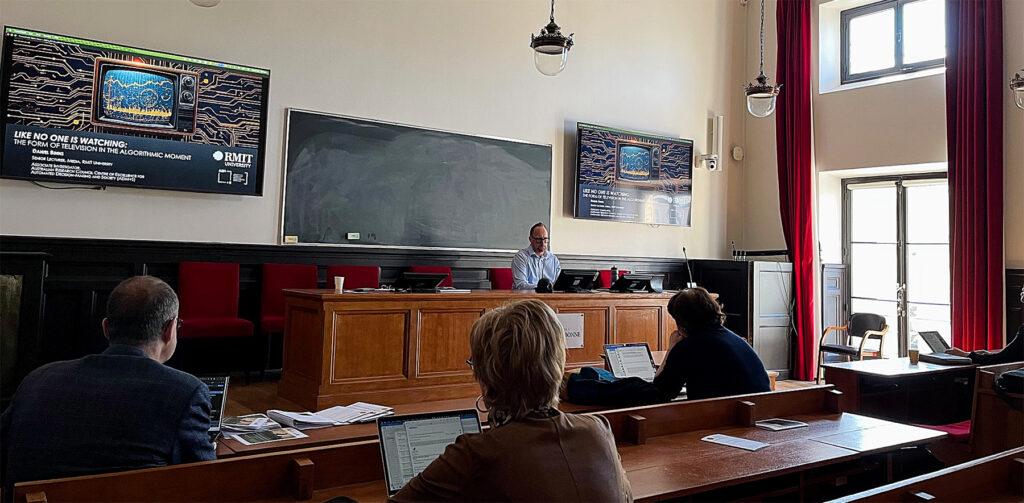
Giving my talk at Université Paris 1-Panthéon Sorbonne. Photo thanks to Sandra Laugier.
I now have a little breathing room before my second presentation, so I’ll be using this time to actually get out and wander around Paris a little, but also to feed and tend to a few items moving through the publication pipeline.
In putting together a few bits and bobs for academic work on generative AI and creativity, I’m poking around in all sorts of strange places, where all manner of undead monsters lurk.
The notion of AI-generated entertainment is not a new one, but the first recent start-up I found in the space was Hypercinema. The copy on the website is typically vague, but I think the company is attempting to build apps for sites like stores, museums and theme parks that add visitors into virtual experiences or branded narratives.
After noodling about on Hypercinema’s LinkedIn and X pages, it wasn’t long before I then found Fable Studios and their Showrunner project; from there it was but a hop, skip and a jump to Showrunner’s parent concept, The Simulation.
Sim Francisco; what I’m assuming is an artist’s rendition. Sourced from The Simulation on X.
The Simulation is a project being developed by Fable Studios, a group of techies and storytellers who are interested in a seamless blend of their respective knowledges. To quote their recent announcement: “We believe the future is a mix of game & movie. Simulations powering 1000s of Truman Shows populated by interactive AI characters.” I realise this is still all guff. From what I can tell, The Simulation is a sandbox virtual world populated by a huge variety of AI characters. The idea is that you can guide the AI characters, influencing their lives and decisions; you can then also zoom into a particular character or setting, then ask The Simulation to generate an ‘entertainment’ for you of a particular length, e.g. a 20-minute episode.
In 2023, Fable Studios released a research paper on their initial work on ‘showrunner agents in multi-agent simulations’. To date, one of the largest issues with AI-generated narratives is that character and plot logics nearly always fall apart; the machine learning systems cannot keep track over prolonged story arcs. In conventional TV/film production, this sort of thing is the role of the director, often in conjunction with the continuity team and first assistant director. But genAI systems are by and large predictive content machines; they’ll examine the context of a given moment and then build the next moment from there, then repeat, then repeat. This process isn’t driven by ‘continuity’ in a traditional cinematic or even narrative sense, but by the cold logic of computation:
“[A] computer running a program, if left powered up, can sit in a loop and run forever, never losing energy or enthusiasm. It’s a metamechanical machine that never experiences surface friction and is never subject to the forces of gravity like a real mechanical machine – so it runs in complete perfection.”
John Maeda, How to Speak Machine, p3
The ML system will repeat the same process over and over again, but note that it does not reframe its entire context from moment to moment, in the way that humans might. The ML system starts again with the next moment, then starts again. This is why generating video with ML tools is so difficult (at least, it still is at the time of writing).
What if, though, you make a video game, with a set of characters with their own motivations and relationships, and you just let life continue, let characters grow, as per a set of rules? Many sandbox or simulation games can be described in this way. There are also some open-world role-playing games that play out against what feels like a simulated, continous world that exists with or without the player character. The player character, in this latter example, becomes the focaliser, the lens through which action is framed, or from which the narrative emerges. And in the case of simulators or city-builders, it’s the experience of planning out your little world, the embedding of your gameplay choices into the lives of virtual people (as either biography or extended history), that embodies the experience. What The Simulation proposes is similar to both these experiences, but at scale.
A selection of apparently-upcoming offerings from Showrunner. I believe these are meant to have been generated in/by The Simulation? Sourced from The Simulation on X.
Sim Francisco is the first megacity that The Simulation has built, and they’re presently working on Neo-Tokyo. These virtual cities are the storyworlds within which you can, supposedly, find your stories. AI creators can jump into these cities, find characters to influence, and then prompt another AI system to capture the ensuing narrative. Again, this is all wild speculation, and the specific mechanics, beyond a couple of vague in-experience clips, are a mystery.
As is my wont, I’m ever reminded of precedents, not least of which were the types of games discussed above: SimCity, The Sims, The Movies, even back to the old classic Microsoft 3D Movie Maker, but also Skyrim, Grand Theft Auto, Cyberpunk 2077. All of these offer some kind of open-world sandbox element that allows the player to craft their own experience. Elements of these examples seem like they might almost be directly ported to The Simulation: influencing AI characters as in The Sims, or directing them specifically as in 3D Movie Maker? Maybe it’ll be a little less direct, where you simply arrange certain elements and watch the result, like in The Movies. But rather than just the resulting ‘entertainments’, will The Simulation allow users to embody player characters? That way they might then be able to interact with AI characters in single-player, or both AIs and other users in a kind of MMO experience (Fable considers The Simulation to be a kind of Westworld). If this kind of gameplay is combined with graphics like those we’re seeing out of the latest Unreal Engine, this could be Something Else.
But then, isn’t this just another CyberTown? Another Second Life? Surely the same problems that plagued (sometimes continue to plague) those projects will recur here. And didn’t we just leave some of this nonsense behind us with web3? Even in the last few months, desperateexperiments around extended realities have fallen flat; wholesale virtual worlds might not be the goût du moment, er, maintenant. But then, if the generative entertainment feature works well, and the audience becomes invested in their favourite little sim-characters, maybe it’ll kick off.
It’s hard to know anything for sure without actually seeing the mechanics of it all. That said, the alpha of Showrunner is presently taking applications, so maybe a glimpse under the hood is more possible than it seems.
Based on this snippet from a Claude-generated sitcom script, however, even knowing how it works never guarantees quality.
Claude Burrows? I think not. Screenshot from Claude.Ai.
Post-script: How the above was made
With a nod to looking under the hood, and also documenting my genAI adventures as part of the initial research I mentioned, here’s how I reached the above script snippet from the never-to-be-produced Two Girls, A Guy, and a WeWork.
Initial prompt to Claude:
I have an idea for a sitcom starring three characters: two girls and a guy. One girl works a high-flying corporate job, the other girl has gone back to school to re-train for a new career after being fired. The guy runs a co-working space where the two girls often meet up: most of the sitcom's scenes take place here. What might some possible conflicts be for these characters? How might I develop these into episode plotlines?
Of the resulting extended output, I selected this option to develop further:
Conflict 6: An investor wants to partner with the guy and turn his co-working space into a chain, forcing him to choose between profits and the community vibe his friends love. The girls remind him what really matters.
I liked the idea of a WeWork-esque storyline, and seeing how that might play out in this format and setting. I asked Claude for a plot outline for an episode, which was fine? I guess? Then asked it to generate a draft script for the scene between the workspace owner (one of our main characters) and the potential investor.
To be fair to the machine, the quality isn’t awful, particularly by sitcom standards. And once I started thinking about sitcom regulars who might play certain characters, the dialogue seemed to make a little more sense, even if said actors would be near-impossible at best, and necromantic at worst.
This city is the self-proclaimed centre of democracy, science, and culture. Unlike many other self-proclaimed centres, though, this one’s claims tend to be borne out by history.
I landed yesterday, blinked and nodded politely as my lovely driver gave me the rundown on the city he’s doubtless done a million times before. Got to the apartment, dumped my everything, found a cold beer in the fridge and toasted my own arrival.
As I took my first few tentative steps out into the streets, an all-caps message arrived from my partner: Anthony Bourdain was dead.
Before we get into this, it must be said that I never met the man. But it’s testament to his talent as a presenter, as a writer, as a storyteller, as a presence, that the news of his passing felt like a punch to the fucking gut.
Between a full-time job each, my partner and I struggle to find time to sit down and smash TV shows — particularly those of the intellectual variety. But during a prolonged fortnight of illness some two or three years ago, The Layover popped up on Netflix, and we destroyed it. Since then we’ve watched nearly all of No Reservations and every episode of Parts Unknown, and between us we’ve read most of the words he wrote. Tony was a source of wisdom on many things, most recently how to prepare garlic: a quick Google that settled a light-hearted argument at work.
Every episode of his series was meticulously planned and shot, playful and experimental, and always accompanied by the most beautifully constructed narration. His crew were seemingly eternally devoted, and clearly thinking above and beyond the necessities of the job; Zach Zamboni’s extended philosophical essays on cinematography have turned up more than once in my reading lists for class.
I was desperately looking forward to seeing the episode Tony shot in Hong Kong that was directed by his girlfriend Asia Argento and shot by the inimitable Christopher Doyle. Now I’m not sure I can bring myself to see it, knowing what we all now do.
In how many fathoms of darkness must a soul be swimming in order for this to be sweet release? Surrounded by those who would take a bullet for you, in how much pain does one need to be to take this action? It must have been insufferable, insurmountable.
I’m just stunned. I’m still getting over this, and will be for some time. In many ways I’m glad to be travelling, at the moment. Anthony Bourdain brought travel down to earth, to the people and their stories, and to the food that locals don’t think twice about scoffing — Tony saw cities not as tourist traps, but as living, breathing places where people do indeed pass through, but people also live, work, and die.
There’s not much to say. Just: thank you, Anthony Bourdain, for your words, your wit, and your way of seeing the world.
The Federal Communications Minister, Malcolm Turnbull, has announced today that licences for community television will not be renewed in 2016. This means all community television stations will stop broadcasting at the end of next year. (more…)