The Clockwork Penguin

Daniel Binns is a media theorist and filmmaker tinkering with the weird edges of technology, storytelling, and screen culture. He is the author of Material Media-Making in the Digital Age and currently writes about posthuman poetics, glitchy machines, and speculative media worlds.

Author: dan

  • Elusive images

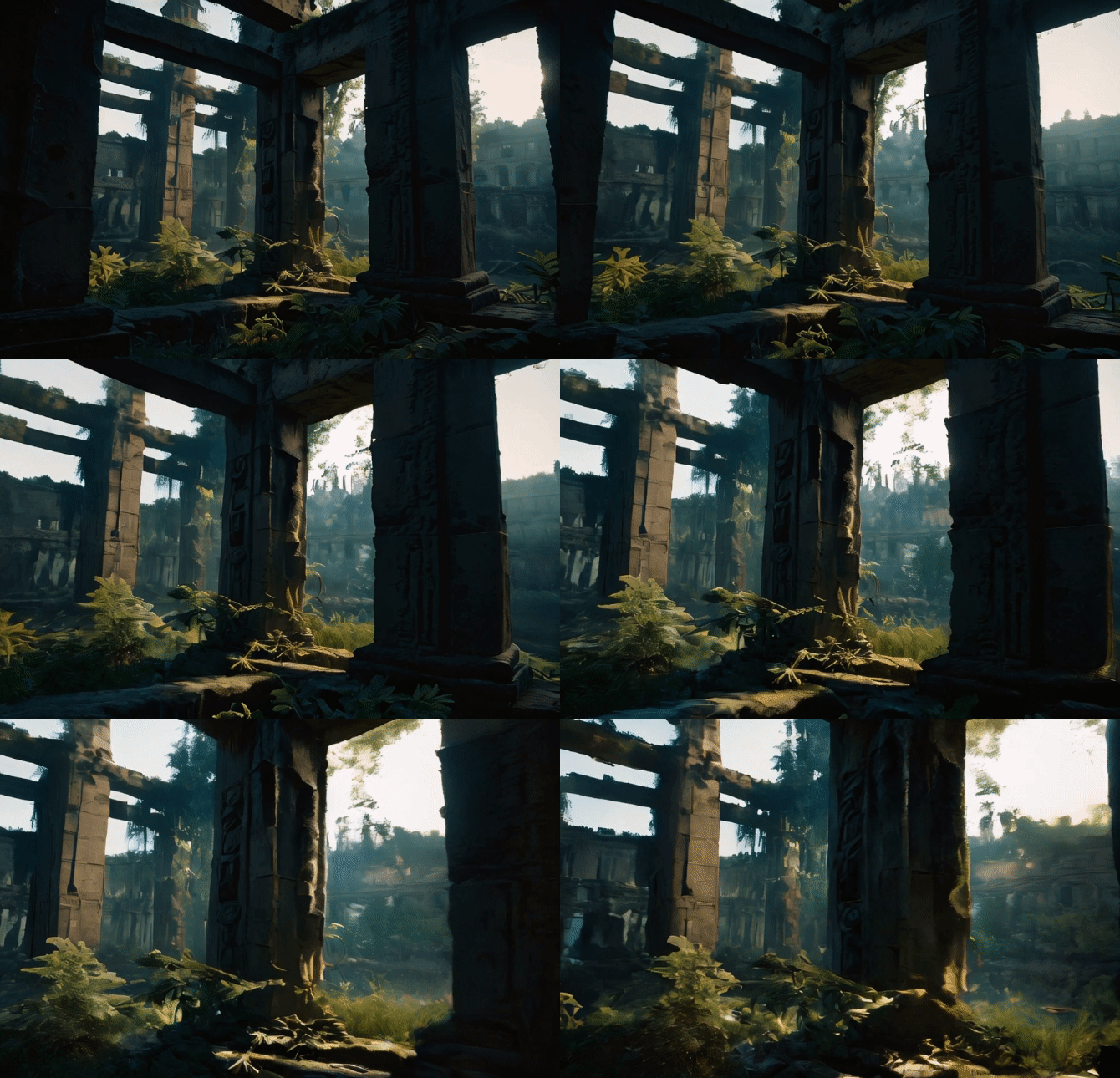
    Generated with Leonardo.Ai, prompts by me.

    Up until this year, AI-generated video was something of a white whale for tech developers. Early experiments resulted in janky-looking acid dream GIFs; vaguely recognisable frames and figures, but nothing in terms of consistent, logical motion. Then things started to get a little, or rather a lot, better. Through constant experimentation and development, the nerds (and I use this term in a nice way) managed to get the machines (and I use this term in a knowingly reductive way) to produce little videos that could have been clips from a film or a human-made animation. To reduce thousands of hours of math and programming into a pithy quotable, the key was this: they encoded time.

    RunwayML and Leonardo.Ai are probably the current forerunners in the space, allowing text-to-image-to-(short)video as a seamless user-driven process. RunwayML also offers text-to-audio generation, which you can then use to generate an animated avatar speaking those words; this avatar can be yourself, another real human, a generated image, or something else entirely. There’s also Pika, Genmo and many others offering variations on this theme.

    Earlier this year, OpenAI announced Sora, their video generation tool. One assumes this will be built into ChatGPT, the chatbot which is serving as the interface for other OpenAI products like DALL-E and custom GPTs. The published results of Sora are pretty staggering, though it’s an open secret that these samples were chosen from many not-so-great results. Critics have also noted that even the supposed exemplars have their flaws. Similar things were said about image generators only a few years ago, though, so one assumes that the current state of things is the worst it will ever be.

    Creators are now experimenting with AI films. The aforementioned RunwayML is currently running their second AI Film Festival in New York. Many AI films are little better than abstract pieces that lack the dynamism and consideration to be called even avant-garde. However, there are a handful that manage to transcend their technical origins. But how this is not true of all media, all art, manages to elude critics and commentators, and worst of all, my fellow scholars.

    It is currently possible, of course, to use AI tools to generate most components, and even to compile found footage into a complete video. But this is an unreliable method that offers little of the creative control that filmmakers might wish for. Creators employ an infinite variety of different tools, workflows, and methods. The simplest might prompt ChatGPT with an idea, ask for a fleshed-out treatment, and then use other tools to generate or source audiovisual material that the user then edits in software like Resolve, Final Cut or Premiere. Others build on this post-production workflow by generating music with Suno or Udio; or they might compose music themselves and have it played by an AI band or orchestra.

    As with everything, though, the tools don’t matter. If the finished product doesn’t have a coherent narrative, theme, or idea, it remains a muddle of modes and outputs that offers nothing to the viewer. ChatGPT may generate some poetic ideas on a theme for you, but you still have to do the cognitive work of fleshing that out, sourcing your media, arranging that media (or guiding a tool to do it for you). Depending on what you cede to the machine, you may or may not be happy with the result — cue more refining, revisiting, more processing, more thinking.

    AI can probably replace us humans for low-stakes media-making, sure. Copywriting, social media ads and posts, the nebulous corporate guff that comprises most of the dead internet. For AI video, the missing component of the formula was time. But for AI film, time-based AI media of any meaning or consequence, encoding time was just the beginning.

    AI media won’t last as a genre or format. Call that wild speculation if you like, but I’m pretty confident in stating it. AI media isn’t a fad, though, I think, in the same ways that blockchain and NFTs were. AI media is showing itself to be a capable content creator and creative collaborator; events like the AI Film Festival are how these tools test and prove themselves in this regard. To choose a handy analogue, the original ‘film’ — celluloid exposed to light to capture an image — still exists. But that format is distinct from film as a form. It’s distinct from film as a cultural idea. From film as a meme or filter. Film, somehow, remains a complex cultural assemblage of technical, social, material and cultural phenomena. Following that historical logic, I don’t think AI media will last in its current technical or cultural form. That’s not to say we shouldn’t be on it right now: quite the opposite, in fact. But to do that, don’t look to the past, or to textbooks, or even to people like me, to be honest. Look to the true creators: the tinkerers, the experimenters, what Apple might once have called the crazy ones.

    Creators and artists have always pushed the boundaries, have always guessed at what matters and what doesn’t, have always shared those guesses with the rest of us. Invariably, those guesses miss some of the mark, but taken collectively they give a good sense of a probable direction. That instinct to take wild stabs is something that LLMs, even a General Artificial Intelligence, will never be truly capable of. Similarly, the complexity of something like, for instance, a novel, or a feature film, eludes these technologies. The ways the tools become embedded, the ways the tools are treated or rejected, the ways they become social or cultural; that’s not for AI tools to do. That’s on us. Anyway, right now AI media is obsessed with its own nature and role in the world; it’s little better than a sequel to 2001: A Space Odyssey or Her. But like those films and countless other media objects, it does itself show us some of the ways we might either lean in to the change, or purposefully resist it. Any thoughts here on your own uses are very welcome!

    The creative and scientific methods blend in a fascinating way with AI media. Developers build tools that do a handful of things; users then learn to daisy-chain those tools together in personal workflows that suit their ideas and processes. To be truly innovative, creators will develop bold and strong original ideas (themes, stories, experiences), and then leverage their workflows to produce those ideas. It’s not just AI media. It’s AI media folded into everything else we already do, use, produce. That’s where the rubber meets the road, so to speak; where a tool or technique becomes the culture. That’s how it worked with printing and publishing, cinema and TV, computers, the internet, and that’s how it will work with AI. That’s where we’re headed. It’s not the singularity. It’s not the end of the world. it’s far more boring and fascinating than either of those could ever hope to be.


  • The roaring 2020s and their spectacular picture palaces

    Blank screen, auditorium to yourself, can’t lose. Photo by me, 18 April 2024.

    I took myself off to the movies lastnight. First time since 1917. The Sam Mendes film I mean, uh, obviously.

    Having gone on my little Godzilla binge earlier in the year, I thought it fitting that I take myself out to the latest instalment. The film itself was fine. Good loud dumb fun. Exactly the same formula as the others. A great soundtrack. Rebecca Hall being her wonderful earnest self. Dan Stevens being… whatever he is now (though he’ll always be Matthew to me). Content to one side, though, it was just great to be in the cinema again. For someone who allegedly studies the stuff from time to time, I don’t watch as much as I’d like; and I certainly don’t go to the cinema often at all. Lastnight showed me I probably should change that.

    I’ve often ruminated, in text and in brain, about the changing media landscape. I’m far from the only one, and recently Paris Marx put up a post about his quest to find Dune: Part One on home media. This story resonated with me. I have a sizeable physical media collection; it’s a dear asset and hobby, and one I am constantly surprised is not even close to mainstream nowadays.

    The production of physical has shifted considerably as demand has waned in the streaming era. DVDs are still, somehow, fairly popular; mostly due to an ageing and/or non-discerning audience (though that last bastion of DVDs, the supermarket DVD section, seems to have died off, finally). Blurays maintain a fair market share, but still require specialist hardware and are region-locked. Despite 4K Blurays being region-free and, with even a semi-decent TV, utterly gorgeous, they hold next to nothing of the market, being really only targeted at huge AV nerds like me.

    During COVID, the streaming platforms cemented their place in the homes and lives of everyone. I am certainly no exception to this. It was insanely convenient to have pretty much the world’s media output at the touch of a button. It was a good time: subscription prices were still relatively low, and the catalogues were decent enough to be worth having more than one or two services on the Apple TV at any given time.

    Netflix, Stan (an Aussie streaming service), and Prime Video were staples. They were also producing their own content, so in a way, they were modelling themselves on the megalithic studios of yore — as producers, distributors, marketers, even as archivists of popular culture.

    Things change, of course. They always do.

    Post-COVID, catalogues were culled. Most streaming services were operating, if not at a loss, then at least just breaking even with the equation of producing original content and/or buying distribution rights to older properties, or just other stuff in general.

    Then the original producers (in some cases the original studios) figured out they could just do it themselves. Disney+, Paramount+, Sony Core (aka Columbia); their own catalogues, their own archives, their own films straight from the cinema deal to the home media deal with no pesky negotiation.

    Prices for all streaming services have steadily risen over the last few years. For your average household, hell, even your above-average household, having all subscriptions active at one time simply isn’t feasible. It’s usually a question of who’s got what content at what time; or employ our house’s strategy and binge one or two platforms in one- or two-monthly bursts.

    Finding something specific in a given streaming catalogue is not a given. So you either pay Apple or Google or whoever to rent for a day or two or a week or whatever; or you pay them to ‘lease’ a copy of the film for you to view on-demand (they call this ‘buying’ the film). If giving money to the megacorps isn’t what you had in mind, maybe your brain would turn to the possibility of buying a physical copy of said media item for yourself.

    So you load up a web browser and punch in your best local media retailer. In my case, it’s a loud yellow behemoth called JB Hi-Fi; for more obscure titles or editions, it’d be something like Play DVD. These places are thin on the ground and, increasingly, even thin in the cloud. But JB’s physical media collection is dwindling, and has been for years. Their DVD/Bluray shelves used to occupy half of their huge stores; now they have maybe half a dozen tucked down the back, with the old real estate now occupied by more drones, more influencer starter kits, more appliances or pop culture paraphernalia.

    It struck me lastnight, as I headed into the cinema, that perhaps the film experience could see a bit of a bump if streaming services continue to fracture, and if physical media stock continues to disappear. If it’s a specific film that you want to see, and you know it’s on at the cinema, it’s probably more efficient overall to go and see it then and there. There are no guarantees any given film will be put up on a given streaming platform, nor that it will even get a physical media release any more. And if it does appear in either form, what quality will it be in? Would the experience be somehow diminished?

    There’s also something to be said for the sheer ubiquity and disposability of media in our current moment, particularly within the home, or home-based clouds. If I spot something on Netflix, I’ll add it to my List. I may watch it, but 7 times out of 10, I’ll forget it existed; once Netflix changes their catalogue, that item just floats away. I’m not notified; I’m not warned; unless it’s something on my watchlist on Letterboxd, or in a note or something, it just vanishes into the ether. Similarly with home media; if there’s a sale on at JB for Blurays, I might pick up a couple. They’ll then go on the shelf with the many, many others, and it might take years until I eventually get to it.

    There’s an intentionality to seeing a film at the cinema. In general, people are there to be absorbed in a singular experience. To not be distracted. To actually switch off from the outside world. I don’t claim any media superiority; I am a big old tech bro through and through, but there is something to the, ahem, CINEMATIC EXPERIENCE that really does retain the slightest touch of magic.

    So yes, perhaps we will see a little hike in moviegoing, if the platform economy continues to expand, explode, consume. Either that, or torrents will once again be IN for 2025 and beyond. Switch on that VPN and place your bets.

  • Inertia

    Photo by Alexander Zvir, via Pexels.

    Since the interminable Melbourne lockdowns and their horrific effect on the population of the city, my place of work has implemented ‘slow-down’ periods. These are usually timed around the usual holiday periods, e.g. Christmas, Easter, but there’s usually also a slowdown scheduled around mid-semester and mid-year breaks. The idea isn’t exactly to stop work (in this economy? ahahahaha no, peasant.) but rather to skip or postpone any non-essential meetings and spend time on focused work. Most often for teacher-researchers like myself, this constitutes catching up on marking assignments or prepping for the coming weeks of classes, though sometimes we can scrape up some time to think about long-gestating research projects or creative work. That’s the theory, anyway.

    I will say it’s nice to pause meetings for a week or two. The nature of academic work is (and should be) collaborative, dependent on bouncing ideas off others, working together to solve gnarly pedagogical issues, pooling resources to compile rich and nuanced ciritical work. But if you’re balancing teaching or coordination along with administrative or managerial duties, plus postgraduate supervisions and research stuff, it can be a lot of being on, a lot of just… people work. I’ll throw in a quick disclaimer here that I’m very lucky to have a bunch of lovely colleagues, and the vast majority of my students have been almost saccharinely delightful to work with. It can still be a lot, though, if you’re pretty woeful at scheduling around your energy levels, as I often am. Hashtag high achiever, hashtag people pleaser, hashtag burnout, hashtag hashtag etc etc etc.

    Academics are notorious for keeping weird hours, or for working too much, or for not having any boundaries around work and life. And I say this as someone who has embodied that stereotype with aplomb for years (even pre-academia, to be honest). I’ve had many conversations with colleagues where we bemoan working late into the evening, or over the weekend, or around other commitments. I’ve often been hard-pressed to find anyone who has any hard boundaries around work and not-work.

    Taking extended leave last year was the first time I’ve ever properly stopped working. No sneaky finishing of research projects, no brainstorming the next media class, no cheeky research reading, no emails. It showed me many things, but primarily how insidious work can be for someone with my disposition and approach to life in general. It is also insidious when you are passionate, and when you care. I care deeply about media education and research, and have become familiar with its rhythms and contours, its stresses and its delights, its (many) foibles and much deeper issues. I care about students and ensuring they feel not just ‘delivered to’ or ‘spoken at’, but rather that they’re exposed to new ways of thinking; inspired to learn well beyond graduation, indeed, to never stop learning; enabled and empowered to tell their stories, and whatever stories they want to tell. I care about producing research, e.g. journal articles, video essays, presentations and events, that is not tired, stale, staid, boring, dense, conventional, but rather is experimental, vibrant, connected, open-ended, and appeals broadly across multiple disciplines and outside the academy.

    I’m not alone here. As mentioned above, I have colleagues who almost universally feel exactly the same way. And I’ve built a local and international research network who share these passions and questions and concerns. A global support group. I’m very lucky and privileged in this way.

    But yeah: all this shit is fucking exhausting. The environment, the sector, the period, certainly doesn’t help. The current model of academia, university management, tertiary education, the industry/academy nexus, capitalism (in summary: neoliberalism), all of it is quite happy to capitalise on passion, on modern productivity dicta around never-being-done, irons-in-the-fire, publish or perish, manage it all or die, no life for you, hang the consequences and anyone you’re dealing with who isn’t work (e.g. partners, kids, friends, families). To anyone who says academics have a cushy job and get paid too much: kindly take yourself into the sea, thanks. That may have been true in the past, but we’re living on the other side of whatever spectrum you’re looking at.

    Suffice to say, slowdowns are nice. Taking proper breaks and/or having an executive echelon that genuinely supports and structures wellbeing and balance would be ideal, but beggars can’t be choosers.

  • Blinded by machine visions

    A grainy, indistinct black and white image of a human figure wearing a suit and tie. The bright photo grain covers his eyes like a blindfold.
    Generated with Adobe Firefly, prompts by me.

    I threw around a quick response to this article on the socials this morning and, in particular, some of the reactions I was seeing. Here’s the money quote from photographer Annie Leibovitz, when asked about the effects of AI tools, generative AI technology, etc, on photography:

    “That doesn’t worry me at all,” she told AFP. “With each technological progress, there are hesitations and concerns. You just have to take the plunge and learn how to use it.”1

    The paraphrased quotes continue on the following lines:

    She says AI-generated images are no less authentic than photography.

    “Photography itself is not really real… I like to use PhotoShop. I use all the tools available.”

    Even deciding how to frame a shot implies “editing and control on some level,” she added.2

    A great many folx were posting responses akin to ‘Annie doesn’t count because she’s in the 1%’ or ‘she doesn’t count because she’s successful’, ‘she doesn’t have to worry anymore’ etc etc.

    On the one hand it’s typical reactionary stuff with which the socials are often ablaze. On the other hand, it’s fair to fear the impact of a given innovation on your livelihood or your passion.

    As I hint in my own posts3, though, I think the temptation to leap on this as privilege is premature, and a little symptomatic of whatever The Culture and/or The Discourse is at the moment, and has been for the duration of the platformed web, if not much longer.

    Leibovitz is and has always been a jobbing artist. Sure, in later years she has been able to pick and choose a little more, but by all accounts she is a busy and determined professional, treating every job with just as much time, effort, dedication as she always has. The work, for Leibovitz, has value, just as much — if not more — than the product or the paycheck.

    I don’t mean to suddenly act my age, or appear much older and grumpier than I am, but I do wonder about how much time aspiring or current photographers spend online discussing and/or worrying and/or reacting to the latest update or the current fad-of-the-moment. I 100% understand the need for today’s artists and creators to engage in some way with the social web, if only to put their names out there to try and secure work. But if you’re living in the comments, whipping yourselves and others into a frenzy about AI or whatever it is, is that really the best use of your time?

    The irony of me asking such questions on a blog where I do nothing but post and react is not lost on me, but this blog for me is a scratchpad, a testing ground, a commonplace book; it’s a core part of my ‘process’, whatever that is, and whatever it’s for. This is practice for other writing, for future writing, for my identity, career, creative endeavours as a writer. It’s a safe space; I’m not getting angry (necessarily), or seeking out things to be angry about.

    But I digress. Leibovitz is not scared of AI. And as someone currently working in this space, I can’t disagree. Having even a rudimentary understanding of what these tools are actually doing will dispel some of the fear.

    Further, photography, like the cinema that it birthed, has already died a thousand deaths, and will die a thousand more.

    Brilliant4 photography lecturer and scholar Alison Bennett speaks to the legacy and persistence of photographic practice here:

    “Recent examples [of pivotal moments of change in photography] include the transition from analogue film to digital media in the late 20th century, then the introduction of the internet-connected smart phone from 2007,” they said.

    “These changes fundamentally redefined what was possible and how photography was used.

    “The AI tipping point is just another example of how photography is constantly being redefined.”5

    As ever, the tools are not the problem. The real enemies are the companies and people that are driving the tools into the mainstream at scale. The companies that train their models on unlicensed datasets, drawn from copyrighted material. The people that buy into their own bullshit about AI and AGI being some kind of evolutionary and/or quasi-biblical moment.

    For every post shitting on Annie Leibovitz, you must have at least twenty posts actively shitting on OpenAI and their ilk, pushing for ethically-sourced and maintained datasets, pushing for systemic change to the resource management of AI systems, including sustainable data centers.

    The larger conceptual questions are around authenticity and around hard work. If you use AI tools, are you still an authentic artist? Aren’t AI tools just a shortcut? Of course, the answers are ‘not necessarily’. If you’ve still done the hard yards to learn about your craft, to learn about how you work, to discover what kinds of stories and experiences you want to create, to find your voice, in whatever form it takes, then generative AI is a paintbrush. A weird-looking paintbrush, but a paintbrush nevertheless (or plasticine, or canvas, or glitter, or an app, etc. etc. ad infinitum).

    Do the work, and you too can be either as ambivalent as Leibovitz, or as surprised and delighted as you want to be. Either way, you’re still in control.

    Notes ↩︎

    1. Agence France-Presse 2024, ‘Photographer Annie Leibovitz: “AI doesn’t worry me at all”’, France 24, viewed 26 March 2024, <https://www.france24.com/en/live-news/20240320-photographer-annie-leibovitz-ai-doesn-t-worry-me-at-all>.
      ↩︎
    2. ibid. ↩︎
    3. See here, and with tiny edits for platform affordances here and here. What’s the opposite of POSSE? PEPOS? ↩︎
    4. I am somewhat biased as, at the time of writing, Dr. Bennett and I currently share a place of work. To look through their expanded (heh) works, go here. ↩︎
    5. Odell, T 2024, ‘New exhibition explores AI’s influence on the future of photography’, RMIT University, viewed 26 March 2024, <https://www.rmit.edu.au/news/all-news/2024/mar/photo-2024>.
      ↩︎
  • All the King’s horses

    Seems about right. Generated with Leonardo.Ai, prompts by me.

    I’ve written previously about the apps I use. When it comes to actual productivity methods, though, I’m usually in one of (what I hope are only) two modes: Complicate Mode (CM) or Simplify Mode (SM).

    CM can be fun because it’s not always about a feeling of overwhelm, or over-complicating things. In its healthier form it might be learning about new modes and methods, discovering new ways I could optimise, satiating my manic monkey brain with lots of shiny new tools, and generally wilfully being in the weeds of it all.

    However CM can also really suck, because it absolutely can feel overwhelming, and it can absolutely feel like I’m lost in the weeds, stuck in the mud, too distracted by the new systems and tools and not actually doing anything. CM can also feel like a plateau, like nothing is working, like the wheels are spinning and I don’t know how to get traction again.

    By contrast, SM usually arrives just after one of these stuck-in-the-mud periods, when I’m just tired and over it. I liken it to a certain point on a long flight. I’m a fairly anxious flyer. Never so much that it’s stopped me travelling, but it’s never an A1 top-tier experience for me. However, on a long-haul flight, usually around 3-5 hours in, it feels like I just ‘run out’ of stress. I know this isn’t what’s actually happening, but it seems like I worked myself up too much, and my body just calms itself enough to be resigned to its situation. And then I’m basically just tired and bored for the remainder of the trip.

    So when I’ve had a period of overwhelm, a period of not getting things done, this usually coincides with CM. I say to myself, “If I can just find the right system, tool, method, app, hack, I’ll get out of this rut.” This is bad CM. Not-healthy CM. Once I’m out of that, though (which, for future self-reference, is never as a result of a Shiny New Thing), I’ll usually slide into SM, when I want to ease out of that mode, take care of myself a bit, be realistic, and strip things back to basics. This is usually not just in terms of productivity/work, but usually extends to overall wellbeing, relationships, creativity, lifestyle, fun: all the non-work stuff, basically.

    The first sign I’m heading into SM is that I’ll unsubscribe from a bunch of app subscriptions (and reading/watching subscriptions too), go back through my bank history to make sure I’m not being charged for anything I’m not into or actively using right now, and note down some simple short-term lifestyle goals (e.g. try to get to the gym in the next few days, meditate every other day, go touch grass or look at a body of water once a week etc). In terms of work, it’s equally simple: try to pick a couple of simple tasks to achieve each day (usually not very brain-heavy) and one large task for the next week/fortnight that I spend a little time on each workday as one of those simple smaller tasks. For instance, I might be working on a journal article; so spending a little time on this during SM might not be writing, per se, but maybe consolidating references, or doing a little reading and note-taking for references I already have but haven’t utilised, or even just a spell-check of what I’ve done so far.

    Phase 1 of SM is usually the above, which I tend to do unconsciously after weeks of stressing myself out and running myself ragged and somehow still doing the essentials of life and work, despite shaving hours, if not days, off my life. Basically, Phase 1 of SM constitutes a bunch of exceptionally good and healthy things to do that I probably should do more regularly to cut off stressful times at the pass; thanks self-preservation brain!

    In terms of strictly productivity, though, SM has previously meant chucking it all in and going back to pen and paper, or chucking in pen and paper and going all in on digital tools (or just one digital tool, which has never worked bro so stop trying it). An even worse thing to do is to go all in on a single new productivity system. This usually takes up a whole day (sometimes two) where I could be either doing shit, or trying to spend quality time figuring out more accurately why shit isn’t getting done, or — probably more to the point — putting everything to one side and giving myself an actual break.

    I’ve had one or two moments of utter desperation, when nothing at all seems like it’s working, when I’ve tried CM and SM and every-other-M to no avail; I’ve even tried taking a bit of a break, but needs must when it comes to somehow just pushing on for whatever reason (personal, financial, professional, psychological, etc). In these moments I’ve had to do a pretty serious and comprehensive life audit. Basically, it’s either whatever note-taking app I see first on my phone, or piece of paper (preferably larger than A4/letter and a bunch of textas, or even just whole bunch of post-it’s and a dream. Make a hot beverage or fill up that water bottle, sit down at desk, dining table, lie in bed or on the floor, and go for it.

    Life Audit Part 1: Commitments and needs/wants

    What are your primary commitments? Your main stressors right now? What are your other stressors? Who are you accountable to/for, or responsible for right now? What do you need to be doing (but actually really need, not just think you need) in only the short-term? What do you want to be doing? What are you paying for right now, obviously financially, but what about physically? Psychologically?

    Life Audit Part 2: Sit Rep

    As it stands right now, how are you answering all the questions from Part 1? Are you kinda lying to yourself about what’s most important? How on earth did you get to the place where you think X is more important than Y? What can you remove from this map to simplify things right now? (Don’t actually remove them, just note down somewhere what you could remove.)

    Life Audit Part 3: Tweak and Adjust

    What tools, systems, methods — if any — do you have in place to cope with any of the foregoing? If you have a method/methods, are they really working? What might you tweak/change/add/remove to streamline or improve this system? If you don’t have any systems right now, what simple approach could you try as a light touch in the coming days or weeks? This could be as simple as blocking out your work time and personal time as work time and personal time, and setting a calendar reminder to try and keep to those times. If you struggle to rest or to give time to important people in your life; why? If your audit is richly developed or super-connected around personal development or lifestyle, or around professional commitments, maybe you need to carve out some time (or not even time, just some headspace) to note down how you can reorient yourself.

    The life audit might be refreshing or energising for some folx, and that’s awesome. For me, though, doing this was taxing. Exhausting. Sometimes debilitating. Maybe doing it more regularly would help, but it really surfaced patterns of thinking and behaviour that had cost me greatly in terms of well-being, welfare, health, time, money, and more besides. So take this as a bit of a disclaimer or warning. It might be good to raise this idea with a loved one or health-type person (GP, psych, religious advisor, etc) before attempting.

    Similarly, maybe a bit of a further disclaimer here. I have read a lot about productivity methods, modes, approaches, gurus, culture, media, and more. I think productivity is something of a myth, and it can also be toxic and dangerous. My personal journey in productivity media and culture has been both a professional interest and a personal interest (at times, obsession). My system probably won’t work for you or anyone really. I’ve learned to tweak, to leave to one side, to adjust and change when needed, and to just drop any pretense of being ‘productive’ if it just ain’t happening.

    Productivity and self-optimisation and their attendant culture are by-products of a capitalist system1. When we buy into it — psychologically, professionally, or financially — we propagate and perpetuate that system, with its prejudices, its injustices, its biases, and its genuine harms. We might kid ourselves that it’s just for us, it’s just the tonic we need to get going, to be a better employee, partner, friend, or whatever; but when it all boils down to it, we’re human. We’re animals. We’re fallible. There are no hacks, there are no shortcuts, and honestly, when it boils down to it, you just have to do the work. And that work is often hard and/or boring and/or time-consuming. I am finally acknowledging and owning this for myself after several years of ignorance. It’s the least any of us can do if we care.


    This post is a line in the sand with my personal journey. To end a chapter. Turn a page. To think through what I’ve tried at various times; to try and give little names and labels to approaches and little recovery methods that I think have been most effective, so that I can just pick them up in future as a little package, a little pill to quickly swallow, rather than inefficiently stumbling my way back to the same solutions via Stress Alley and Burnout Junction.

    Moving forward, I also want to linger a little longer in the last couple of paragraphs. But for real this time. It’s easy to say that I believe in slowing down, in valuing life and whatever it brings me, to just spend time: not doing anything necessarily, but certainly not worrying about whether or not I’m being productive or doing the right thing.

    I want to have a simple system that facilitates my being the kind of employee I want to be; the kind of colleague I want to be; the partner I want to be; the immediate family member (e.g. child, parent, grandchild etc) I want to be; the citizen, human I want to be. This isn’t some lofty ambition talking. I’m realistic about how much space in the world I am taking up: it’s both more than I ever have, but also far from as much as those people (you know who I mean). I want time and space to work on being all of these people, while also — hopefully — making some changes to leave things in a slightly better way than I found them.

    How’s that for a system?

    Notes

    1. For an outstanding breakdown of what I mean by this, please read Melissa Gregg’s excellent monograph Counterproductive: Time Management in the Knowledge Economy. ↩︎