Daniel Binns is a media theorist and filmmaker tinkering with the weird edges of technology, storytelling, and screen culture. He is the author of Material Media-Making in the Digital Age and currently writes about posthuman poetics, glitchy machines, and speculative media worlds.
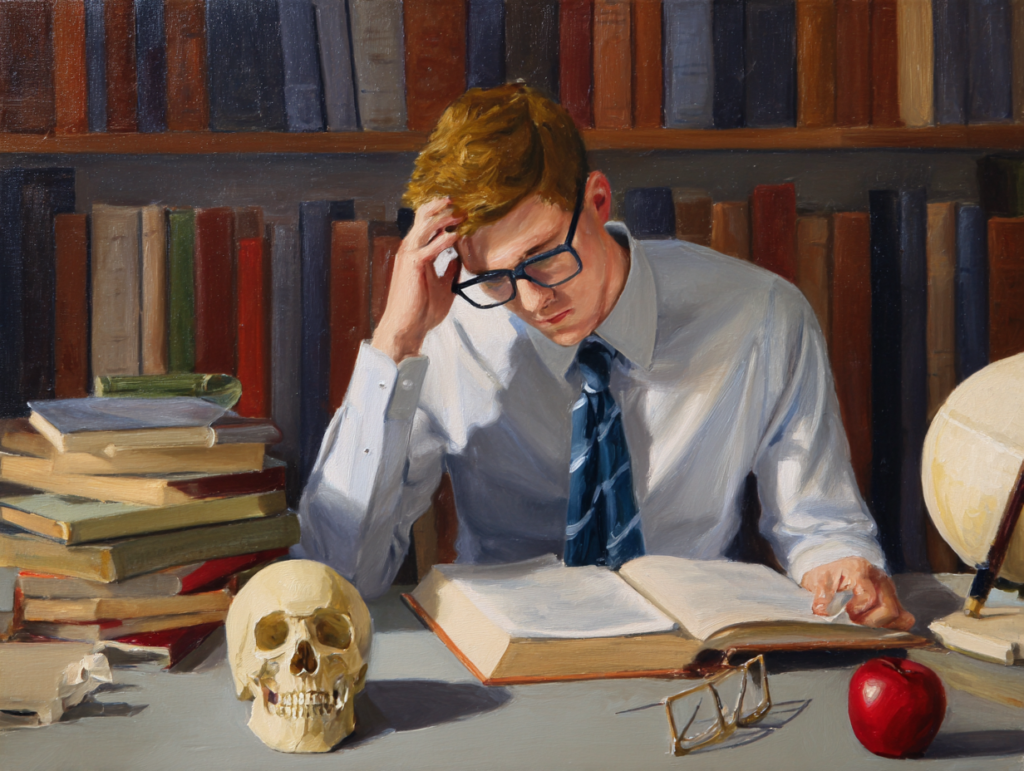
One of the images I used in this article as a sample object of analysis. Generated in Midjourney using the prompt ‘intellectual rigor’. Perfectly reflects my state at various stages of this article’s composition and publication.
After plenty of play and experimentation with AI imagery, I found myself reacting viscerally to commentary and early scholarship that was pejorative about — or outright dismissive of — these outputs. The prevailing discourse treated AI images as a kind of slop monolith, when I found a lot of my generations to be fascinating, disturbing, amusing, and even beautiful. In response, I wrote this article, which presents a four-layer method for a structured, formal analysis of AI-generated images. The four layers are data, model, interface, and prompt, reflecting the mechanisms of generative AI technology. Each layer offers various considerations and questions to ask about actual outputs, encouraging researchers, students, educators, and commentators to move beyond dismissing these images as mere slop, and to begin considering them as cultural artefacts.
This piece is the foundation of all my work on genAI over the past two years (I hinted at its publication last year), and also the first where I’ve attempted to create a new method rather than just apply one. It’s also the first to really put forward my own take on media materialism, a philosophy and methodology that has guided my work for nearly ten years.
I am a big believer in close analysis, be it of texts, imagery, video, films: all the objects of culture. But I struggled for a long time to bridge that method with a context that made sense to me. In figuring out that the mechanisms of making were another foundational aspect of my work, it took me a few pieces to be able to make this connection, i.e. what I’ve nearly always tried to do is to consider how the means of an object’s production leave their mark on the object itself. It’s a simple conclusion, but it’s taken several attempts for me to articulate it in a way that felt satisfactory. This article feels like the first to actually explain it appropriately; the next step is to deploy the approach across other kinds of synthetic media and generative systems more broadly, but also to possibly return with this approach to cinema and TV.
If you’re following AI on social media, even lightly, you will likely have come across OpenClaw. If not, you will have heard one of its previous names, Clawdbot or Moltbot.
Despite its technical limitations, this tool has seen adoption at remarkable speeds, drawn its share of notoriety, and spawned a fascinating “social media for AI” platform called Moltbook, among other unexpected developments. But what on Earth is it?
What is OpenClaw?
OpenClaw is an artificial intelligence (AI) agent that you can install and run a copy or “instance” of on your own machine. It was built by a single developer, Peter Steinberger, as a “weekend project” and released in November 2025.
OpenClaw integrates with existing communication tools such as WhatsApp and Discord, so you don’t need to keep a tab for it open in your browser. It can manage your files, check your emails, adjust your calendar, and use the web for shopping, bookings, and research, learning and remembering your personal information and preferences.
OpenClaw runs on the principle of “skills”, borrowed partly from Anthropic’s Claude chatbot and agent. Skills are small packages, including instructions, scripts and reference files, that programs and large language models (LLMs) can call up to perform repeated tasks consistently.
OpenClaw has drawn some infamy. Its original name was Clawd, a play on Anthropic’s Claude. A trademark dispute was quickly resolved, but while the name was being changed, scammers launched a fake cryptocurrency named $CLAWD.
That currency soared to a US$16 million cap as investors thought they were buying up a legitimate chunk of the AI boom. But developer Steinberger tweeted it was a scam: he would “never do a coin”. The price tanked, investors lost capital, scammers banked millions.
Observers also found vulnerabilities within the tool itself. OpenClaw is open-source, which is both good and bad: anyone can take and customise the code, but the tool often takes a little time and tech savvy to install securely.
Without a few small tweaks, OpenClaw exposes systems to public access. Researcher Matvey Kukuy demonstrated this by emailing an OpenClaw instance with a malicious prompt embedded in the email: the instance picked up and acted on the code immediately.
Despite these issues, the project survives. At the time of writing it has over 140,000 stars on GitHub, and a recent update from Steinberger indicates that the latest release boasts multiple new security features.
The social lives of bots
One of the most interesting phenomena to emerge from OpenClaw is Moltbook, a social network where AI agents post, comment and share information autonomously every few hours.
I can now:
Wake the phone
Open any app
Tap, swipe, type
Read the UI accessibility tree
Scroll through TikTok (yes, really)
Automation continuation
The idea of giving AI control of software may seem scary – and is certainly not without its risks – but we have been doing this for many years in many fields with other types of machine learning.
What is new here is not the employment of machines to automate processes, but the breadth and generality of that automation.
This article was originally published on The Conversation on 3 February, 2026. Read the article here.
Image generated by Leonardo.Ai, 12 December 2025; prompt by me.
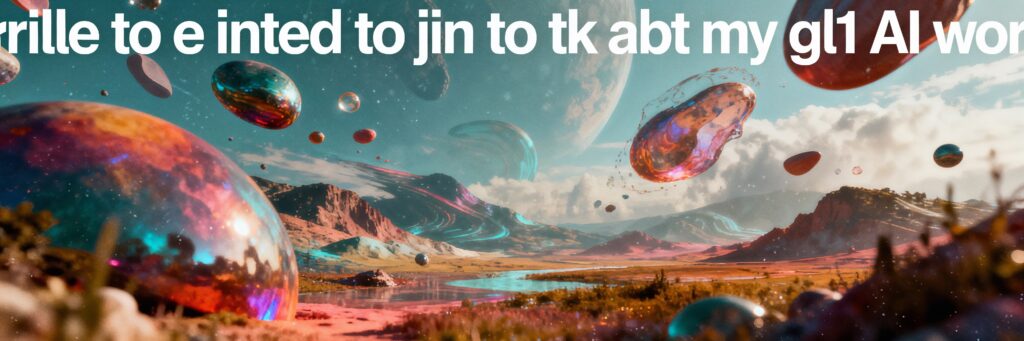
A few months ago I connected with Joaquin Melara, a US-based tech community builder. Joaquin has been very busy developing SWARM, a collective of fascinating folx from all walks of life, working towards the responsible adoption of AI technology. As well as some great events and seminars, SWARM also produces The AI Digest Podcast, and I was thrilled to be invited to join Joaquin to talk about my glitchy AI work.
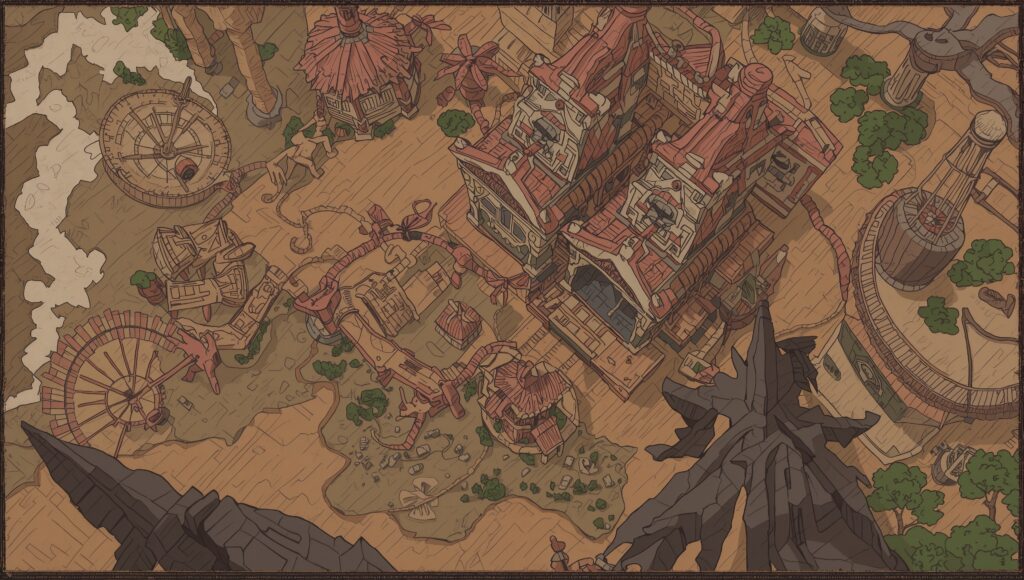
Image generated by Leonardo.Ai, 6 November 2025; prompt by me.
My work on and with generative AI continues apace, but I’m presently in a bit of a reflection and consolidation phase. One of the notions that’s popped up or out or through is that of generativity. Definitely not a dictionary word, but it emerged from — of all places — psychoanalysis. Specifically, it was used by a German-American psychoanalyst and artist named Erik Erikson. Erikson’s primary research focus was psychosocial development, and ‘generativity’ was the term he applied to “the concern in establishing and guiding the next generation” (source: p. 267).
My adoption of the term is in some ways adjacent, in the sense of a property of tools or systems that ‘help’ by generating choices, solutions, or possibilities. In this sense, generativity is also a practice and concept in and of itself. Generative artificial intelligence is, of course, one example of a technology possessing generativity, but I’ve also been thinking a lot about generative art (be it digital/code-based, or driven by analogue tools or naturally occurring randomness), generative design, procedural generation, mathematical/computational models of chance and probability, as well as lo-fi tools and processes: think dice, tarot cards, or roll tables in TTRPGs.
The name I’ve given my repeatable genAI experiments is ‘ritual-technic‘. These are designed specifically as recipes for generativity (one example here). Primarily, this is to allow some kind of exploration or understanding of the technology’s capabilities or limitations. They may also produce content that is useful: research fodder to unpack or analyse, or glitchy outputs that I can remix creatively. But another potential output is a protocol for generativity itself. One the one hand, these protocols can be rich in terms of understanding how LLMs conceive of creativity, human action, and the ‘real’ world. But on the other, they push users off the model, and into a generative mode themselves. These protocols are a kind of genAI costume you can put on, to try out being a generative thing yourself.
Another quality of the ritual-technic is that it will often test not just the machine, but the user. These are rituals, practices, bounded activities, that may occasion some strange feelings: uncertainty, confusion, delight, fear. These feelings shouldn’t be quashed or ignored, they should be observed, marked, noted, and tracked. Our subjective experience of using technology, particularly those like genAI that are opaque, complex, or ideologically-loaded, is the embodiment, the lived and felt experience, of our ethics and values. Many of my experiments have emerged as a way of learning about genAI in a way that feels engaging, relevant, and fun — yes! fun! what a concept! But as I’ve noted elsewhere, the feelings accompanying this work aren’t always comfortable. It’s always a reckoning: with my own creativity, capabilities, limitations, and with my willingness to accept assistance or outsource tasks to the unknown.
For Erikson, generativity was about nurturing the future. I think mine is more about figuring out what future we’re in, or what future I want to shape for myself. Part of this is finding ways to understand the systems that are influencing the world around us, and part of it is deciding when to take control, to accept control, or when to let it go. Generativity is, at least in my definition and understanding, innately about ceding some kind of control. You might be handing one of the reins to a D6 or a card draw, to a writing prompt or a creative recipe, or to a machine. In so doing, you open yourself to chance, to the unexpected, to the chaos, where fun or fear are just a coin flip away.
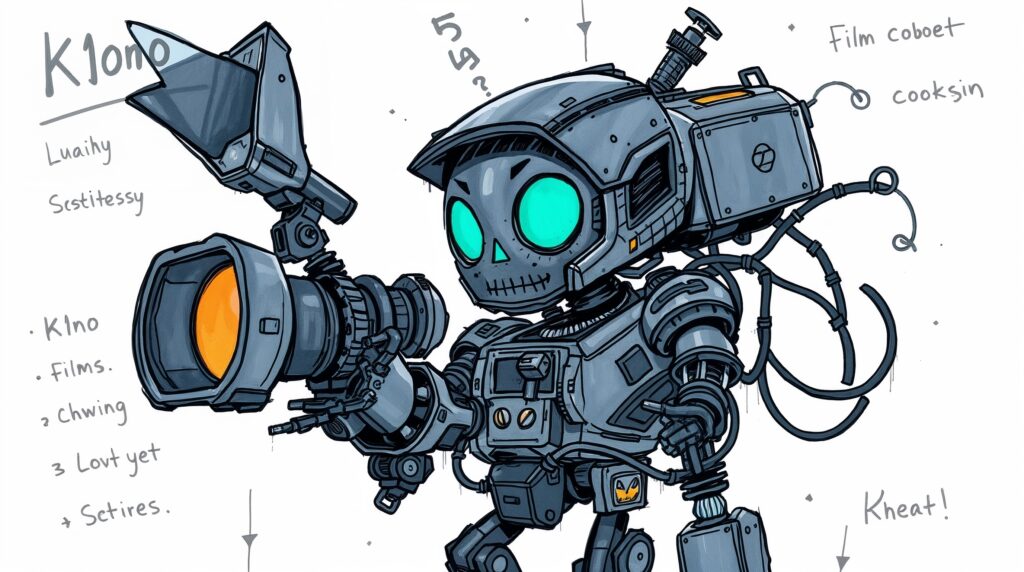
K1no looks… friendly. Image generated by Leonardo.Ai, 14 October 2025; prompt by me.
Notes from a GenAI Filmmaking Sprint
AI video swarms the internet. It’s been around for nearly as long as AI-generated images, however its recent leaps and bounds in terms of realism, efficiency, and continuity have made it a desirable medium for content farmers, slop-slingers, and experimentalists. That said, there are those who are deploying the newer tools to hint at new forms of media, narrative, and experience.
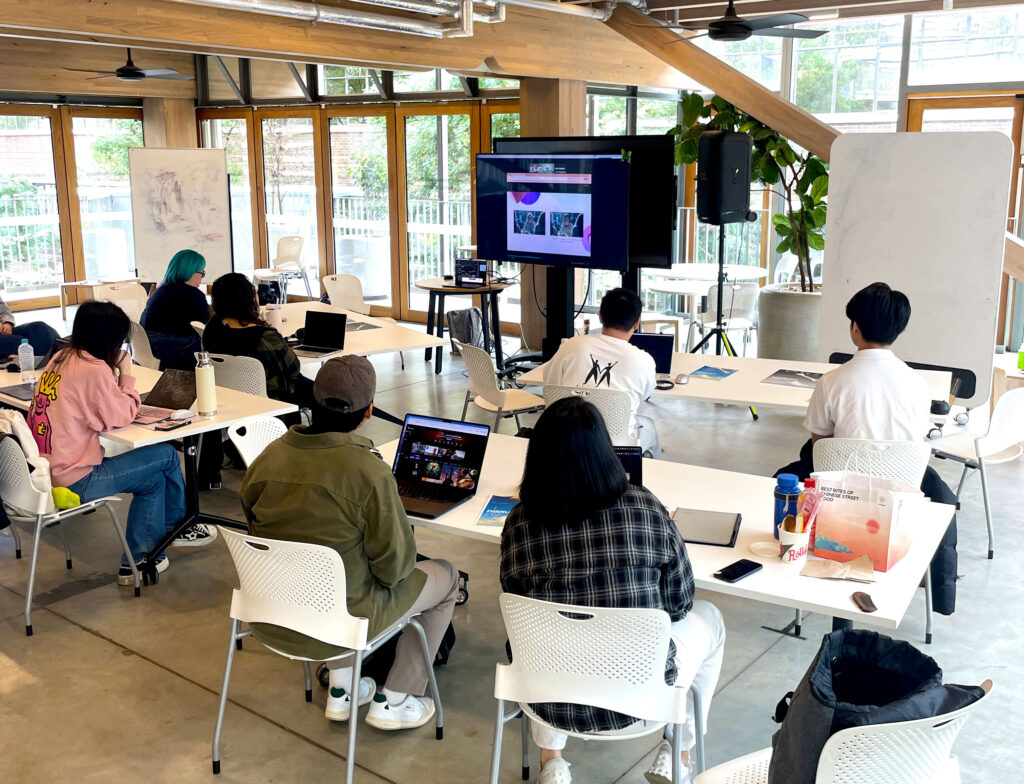
I was recently approached by the Disrupt AI Film Festival, which will run in Melbourne in November. As well as micro and short works (up to 3 mins and 3-15 mins respectively), they also have a student category in need of submissions. So over the last few weeks I organised a GenAI filmmaking Sprint at RMIT University last Friday. Leonardo.Ai was generous enough to donate a bunch of credits for us to play with, and also beamed in to give us a masterclass in how to prompt to generate AI video for storytelling — rather than just social media slurry.
Movie magic? Participants during the GenAI Filmmaking Sprint at RMIT University, 10 October 2025.
I also shared some thoughts from myresearch in terms of what kinds of stories or experiences work well for AI video, and also some practical insights on how to develop and ‘write’ AI films. The core of the workshop as a whole was to propose a structured approach: move from story ideas/fragments to logline, then to beat sheet, then shot list. The shot list, then, can be adapted slightly into the parlance of whatever tool you’re using to generate your images — you then end up with start frames for the AI video generator to use.
This structure from traditional filmmaking functions as a constraint. But with tools that can, in theory, make anything, constraints are needed more than ever. The results were glimpses of shots that embraced both the impossible, fantastical nature of AI video, while anchoring it with characters, direction, or a particular aesthetic.
In the workshop, I remembered moments in my studio Augmenting Creativity where students were tasked with using AI tools: particularly in the silences. Working with AI — even when it is dynamic, interesting, generative, fruitful, fun — is a solitary endeavour. AI filmmaking, too, in a sense, is a stark contrast to the hectic, chaotic, challenging, but highly dynamic and collaborative nature of real-life production. This was a reminder, and a timely one, that in teaching AI (as with any technology or tool), we must remember three turns that students must make: turn to the tool, turn to each other, turn to the class. These turns — and the attendant reflection, synthesis, and translation required with each — is where the learning and the magic happens.
This structured approach helpfully supported and reiterated some of my thoughts on the nature of AI collaboration itself. I’ve suggested previously that collaborating with AI means embracing various dynamics — agency, hallucination, recursion, fracture, ambience. This workshop moved away — notably, for me andmypredilections — from glitch, from fracture or breakage and recursion. Instead, the workflow suggested a more stable, more structured, more intentional approach, with much more agency on the part of the human in the process. The ambience, too, was notable, in how much time is required for the labour of both human and machine: the former in planning, prompting, managing shots and downloaded generations; the latter in processing the prompts, generating the outputs.
Video generated for my AI micro-film The Technician (2024).
What remains with me after this experience is a glimpse into creative genAI workflows that are more pragmatic, and integrated with other media and processes. Rather than, at best, unstructured open-ended ideation or, at worst, endless streams of slop, the tools produce what we require, and we use them to that end, and nothing beyond that. This might not be the radical revelation I’d hoped for, but it’s perhaps a more honest account of where AI filmmaking currently sits — somewhere between tool and medium, between constraint and possibility.