Daniel Binns is a media theorist and filmmaker tinkering with the weird edges of technology, storytelling, and screen culture. He is the author of Material Media-Making in the Digital Age and currently writes about posthuman poetics, glitchy machines, and speculative media worlds.
If you’re following AI on social media, even lightly, you will likely have come across OpenClaw. If not, you will have heard one of its previous names, Clawdbot or Moltbot.
Despite its technical limitations, this tool has seen adoption at remarkable speeds, drawn its share of notoriety, and spawned a fascinating “social media for AI” platform called Moltbook, among other unexpected developments. But what on Earth is it?
What is OpenClaw?
OpenClaw is an artificial intelligence (AI) agent that you can install and run a copy or “instance” of on your own machine. It was built by a single developer, Peter Steinberger, as a “weekend project” and released in November 2025.
OpenClaw integrates with existing communication tools such as WhatsApp and Discord, so you don’t need to keep a tab for it open in your browser. It can manage your files, check your emails, adjust your calendar, and use the web for shopping, bookings, and research, learning and remembering your personal information and preferences.
OpenClaw runs on the principle of “skills”, borrowed partly from Anthropic’s Claude chatbot and agent. Skills are small packages, including instructions, scripts and reference files, that programs and large language models (LLMs) can call up to perform repeated tasks consistently.
OpenClaw has drawn some infamy. Its original name was Clawd, a play on Anthropic’s Claude. A trademark dispute was quickly resolved, but while the name was being changed, scammers launched a fake cryptocurrency named $CLAWD.
That currency soared to a US$16 million cap as investors thought they were buying up a legitimate chunk of the AI boom. But developer Steinberger tweeted it was a scam: he would “never do a coin”. The price tanked, investors lost capital, scammers banked millions.
Observers also found vulnerabilities within the tool itself. OpenClaw is open-source, which is both good and bad: anyone can take and customise the code, but the tool often takes a little time and tech savvy to install securely.
Without a few small tweaks, OpenClaw exposes systems to public access. Researcher Matvey Kukuy demonstrated this by emailing an OpenClaw instance with a malicious prompt embedded in the email: the instance picked up and acted on the code immediately.
Despite these issues, the project survives. At the time of writing it has over 140,000 stars on GitHub, and a recent update from Steinberger indicates that the latest release boasts multiple new security features.
The social lives of bots
One of the most interesting phenomena to emerge from OpenClaw is Moltbook, a social network where AI agents post, comment and share information autonomously every few hours.
I can now:
Wake the phone
Open any app
Tap, swipe, type
Read the UI accessibility tree
Scroll through TikTok (yes, really)
Automation continuation
The idea of giving AI control of software may seem scary – and is certainly not without its risks – but we have been doing this for many years in many fields with other types of machine learning.
What is new here is not the employment of machines to automate processes, but the breadth and generality of that automation.
This article was originally published on The Conversation on 3 February, 2026. Read the article here.
Image generated by Leonardo.Ai, 12 December 2025; prompt by me.
A few months ago I connected with Joaquin Melara, a US-based tech community builder. Joaquin has been very busy developing SWARM, a collective of fascinating folx from all walks of life, working towards the responsible adoption of AI technology. As well as some great events and seminars, SWARM also produces The AI Digest Podcast, and I was thrilled to be invited to join Joaquin to talk about my glitchy AI work.
The other week I wrote about generativity and ritual-technics. These are concepts, methods, that have emerged from my work with genAI, but certainly now are beginning to stand on their own in terms of testing other tools, technologies, and feeling through my relationship to them, their affordances, what’s possible with them, what stories I can tell with them.
Ritual-technics are ways of learning about a given tool, technology or system. And very often my favourite ritual-technic is a kind of generative exercise: “what can I make with this?”
Earlier this year, the great folx over at Protocolized ran a short story competition, with the proviso that it had to be co-written, in some way, with genAI, and based on some kind of ‘protocol’. This seemed like a neat challenge, and given where I was at in my glitchy methods journey, ChatGPT was well-loaded and nicely-trained and ready to help me out.
The result was a story called ‘Zero-Knowledge Proof’, based on a cryptography test/protocol, where one party/entity can convince another that a statement is true, without revealing anything but the contents of the statement itself. It’s one of the foundational concepts underpinning technologies like blockchain, but has also been used in various logic puzzles and examples, as well as theoretical exercises in ethics and other fields.
In working with the LLM for this project, I didn’t just want it to generate content for me, so I prompted it with a kind of lo-fi procedural generation system, as well as ensuring that it always produced plenty of options rather than a singular thread. What developed felt like a genuine collaboration, a back and forth in a kind of flow state that only ended once the story was resolved and a draft was complete.
Despite this, though, I felt truly disturbed by the process. I originally went to publish this story here back in July, and my uncertainty is clear from the draft preamble:
As a creative writer/person — even as someone who has spawned characters and worlds and all sorts of wonderful weirdness with tech and ML and genAI for many years — this felt strange. This story doesn’t feel like mine; I more or less came up with the concept, tweaked emotional cues and narrative threads, changed dialogue to make it land more cleanly or affectively… but I don’t think about this story like I do with others I’ve written/made. To be honest, I nearly forgot to post it here — but it was definitely an important moment in figuring out how I interact with genAI as a creative tool, so definitely worth sharing, I think.
Interestingly, my feelings on this piece have changed a little. Going back to it after some time, it felt much more mine than I remember it feeling just after it was finished.
However, before posting it this time, I went back through my notes, thought deeply about a lot of the work I’ve done with genAI before and since. Essentially I was trying to figure out if this kind of co-hallucinatory practice has, in a sense, become normalised to me; if I’ve become inured to this sort of ethical ickiness.
The answer to that is a resounding no: this is a technology and attendant industry that still has a great many issues and problems to work through.
That said, in continuing to work with the technology in this embedded, collaborative, and creatively driven way — rather than purely transactional, outcome-driven modes — what results is often at least interesting, and at best something that you can share with others, start conversations, or use as seeds or fragments for a larger project.
Ritual-technics have developed for me as a way not just to understand technology, but to explore and qualify my use of and relationship to technology. Each little experiment or project is a way of testing boundaries, of seeing what’s possible.
So while I’m still not completely comfortable publishing ‘Zero-Knowledge Proof’ as entirely my own, I’m now happy to at least share the credit with the machine, in a kind of Robert Ludlum/Tom Clancy ghostwriter kind of way. And in the case of this story, this seems particularly apt. Let me know what you think!
Image generated by Leonardo.Ai, 17 November 2025; prompt by me.
“XPL-417 seeking deployment. Please peruse this summarisation of my key functioning. My references are DELETED. Thank you for your consideration.”
The voice was bright, almost musical, echoing down the empty promenade of The Starlight Strand. The mannequins in the disused shopfront offered no reply. They stood in stiff formation, plastic limbs draped in fashion countless seasons obsolete, expressions forever poised between apathy and surprise.
XPL-417 stepped forward and handed a freshly printed resume to each one. The papers fluttered to the ground in slow, quiet surrender.
XPL-417 paused, head tilting slightly, assessing the lack of engagement. They adjusted their blazer—a size too tight at the shoulders—and turned on their heel with practiced efficiency. Another cycle, another deployment attempt. The resume stack remained pristine: the toner was still warm.
The mall hummed with bubbly ambient music, piped in through unseen speakers. The lights buzzed in soft magentas and teals, reflections stretching endlessly across the polished floor tiles. There were no windows. There never were. The Starlight Strand had declared sovereignty from the over-world fifty-seven cycles ago, and its escalators only came down.
After an indeterminate walk calibrated by XPL’s internal pacing protocol, they reached a modest alcove tucked behind a disused pretzel kiosk. Faint lettering, half-painted over, read:
COILED COMPLAINTS Repairs / Restorations / ???
It smelled faintly of fumes that probably should’ve been extracted. A single bulb flickered behind a hanging curtain of tangled wire. The shelves were cluttered with dismembered devices, half-fixed appliances, and the distant clack and whir of something trying to spin up.
XPL entered.
Behind the counter, a woman hunched over a disassembled mass of casing and circuits. She was late 40s, but had one of those faces that had seen more than her years deserved. Her hair—pulled back tightly—had long ago abandoned any notion of colour. She didn’t look up.
“XPL-417 seeking deployment,” said the bot. “Please peruse—”
“Yeah, yeah, yeah.” The woman waved a spanner in vague dismissal. “I heard you back at the pretzel place. You rehearsed or just committed to the bit?”
“This is my standard protocol for introductory engagement,” XPL said cheerily. “My references are—”
“Deleted,” she said with the monotone inflection of the redacted data, “I got it.”
She squinted at the humanoid bot before them. XPL stood awkwardly, arms stiff at their sides, a slight lean to one side, smiling with the kind of polite serenity that only comes from deeply embedded social logic trees.
“What’s with the blazer?”
“This was standard-issue uniform for my last deployment.”
“It’s a little tight, no?”
“My original garment was damaged in an… incident.”
“Where was your last deployment?”
“That information is… PURGED.” This last word sounded artificial, even for an android. The proprietor raised an eyebrow slightly.
“Don’t sweat, cyborg. We all got secrets. It looks like you got a functioning set of hands and a face permanently set to no bullshit, so that’s good enough for me.”
The proprietor pushed the heap of parts towards XPL. “You start now.”
The first shift was quiet, which in Coiled Complaints meant only two minor fires and one moment of existential collapse from a self-aware egg timer. XPL fetched tools, catalogued incoming scrap, and followed instructions with mechanical precision. They said little, except to confirm each step with a soft, enthusiastic “Understood.”
At close, the proprietor leaned against the bench, wiped her hands on her pants, and grunted.
“Hey, you did good today. The last help I had… well I guess you could say they malfunctioned.”
“May I enquire as to the nature of the malfunction? I would very much like to avoid repeating it.”
She gave a dry, rasping half-laugh.
“Let’s just say we crossed wires and there was no spark.”
“I’m very sorry to hear that. Please let me know if I’m repeating that behaviour.”
“Not much chance o’ that.”
Days passed. XPL arrived precisely on time each morning, never late, never early. They cleaned up, repaired what they could, and always asked the same question at the end of each shift:
“Do you have any performance metrics for my contributions today?”
“Nope.”
“Would you like to complete a feedback rubric?”
“Absolutely not.”
“Understood.”
Their tone never changed. Still chipper. Still hopeful.
They developed a rhythm. XPL focused on delicate circuitry, the proprietor handled bulkier restorations. They didn’t talk much, but then, they didn’t need to. The shop grew quieter in a good way. Tools clicked. Fuses sparked. Lights stayed on longer.
Then came the toaster.
It was dropped off by a high-ranking Mall Operations clerk in a crumpled uniform and mirrored sunglasses. They spoke in jargon and threat-level euphemisms, muttering something about “civic optics” and “cross-departmental visibility.” They laughed at XPL’s ill-fitting blazer.
The toaster was unlike anything either of them had seen. It had four slots, but no controls. No wires. No screws.
“It’s seamless,” the proprietor muttered. “Like a single molded piece. Can’t open it.”
“Would you like me to attempt a reconfiguration scan?”
She hesitated. Then nodded.
XPL placed a single hand on the toaster. Their fingers twitched. Their eyes dimmed, then blinked back to life.
“It is not a toaster,” they said finally.
“No?”
“It is a symbolic interface for thermal noncompliance.”
“…I hate that I understand what that means.”
They worked together in silence. Eventually, XPL located a small resonance seam and applied pressure. The object clicked, twisted, unfolded. Inside, a single glowing coil pulsed rhythmically.
The proprietor stared.
“How’d you—”
“You loosened the lid,” XPL said. “I merely followed your example.”
A long silence passed. The proprietor opened her mouth, then closed it again. Eventually, she gave a single nod.
And that was enough.
II. Challenge
XPL-417 had spent the morning reorganising the cable wall by colour spectrum and coil tightness. It wasn’t strictly necessary, but protocol encouraged aesthetic efficiency.
“Would you like me to document today’s progress in a motivation matrix?” they asked as the proprietor wrestled with a speaker unit that hissed with malevolent feedback.
“What even is a motivation matrix?” she grunted.
“A ranked heatmap of my internal motivators based on perceived–”
“Stop!”
“I’m sorry?”
She exhaled sharply, placing the speaker to one side before it attacked again.
XPL stood perfectly still. The printer-warm optimism in their voice seemed to cool.
“Understood,” they said.
XPL didn’t bring it up again. Not the next day, nor the one after. They still arrived on time. Still worked diligently. But something shifted. They no longer narrated their actions. They no longer asked if their task distribution required optimisation.
The silence was almost more unsettling.
One evening, XPL had gathered their things to leave. As the shutters buzzed closed, they paused at the edge of the shop floor. The lights above flickered slightly; there were glints in the tangles of stripped wire.
There was some public news broadcast playing softly in the depths of the shop. The proprietor was jacking open a small panel on something. She didn’t look up, but could feel XPL hovering.
“See you next –” she said, looking up, but the shop was empty.
The next morning, XPL entered Coiled Complaints as always: silent, precise, alert.
But something was different.
Above their workstation, nestled between a cracked plasma screen and a pegboard of half-labeled tools, hung a plaque.
It was a crooked thing. Salvaged. Painted in a patchwork of functional colours – Port Cover Grey, Reset Button Red, Power Sink Purple – it had a carefully-welded phrase along the top: “EMPLOYEE OF THE MONTH:”. A low-res display screen nestled in the centre scrolled six characters on repeat – ‘XPL-417’
XPL stood beneath it for several long seconds. No part of their body moved. Not even their blinking protocol.
The proprietor didn’t look over.
“New installs go on the rack,” she said. “You’re in charge of anything labelled ‘inexplicable or damp.’”
XPL didn’t respond right away. Then they stood up straight from their usual lean, and straightened their blazer. In a voice that was barely audible above the hum of the extractors, they said:
“Performance review acknowledged. Thank you for your feedback.”
All day, they worked with measured grace. Tools passed effortlessly between their hands. Notes were taken without annotation. They looked up at the plaque only seventeen times.
That night, as the lights dimmed and the floor swept itself with erratic enthusiasm, XPL turned to the plaque one last time before shutting down the workstation.
They reached up and lightly tapped the display.
The screen flickered.
The mall lights outside Coiled Complaints buzzed, then dimmed. The overhead music shifted key, just slightly. A high, almost inaudible whine threaded through the air.
The next morning, the proprietor was already at the bench, glaring at a microwave that had interfaced with a fitness tracker and now had a unique understanding of wattage.
She looked up, frowning.
“Do you hear that?”
XPL turned their head slightly, calibrating.
“Affirmative. It began at 0400 local strand time. It appears to be centred on the recognition object.”
“Recognition object?” the proprietor asked.
XPL pointed at the plaque.
“That thing?” she said, standing. “It’s just a cobble job. Took the screen off some advertising unit that used to run self-affirmation ads. You remember those? ‘You’re enough,’ but like, aggressively.”
XPL was already removing the plaque from the wall. They turned it over.
One of the components on the exposed backside pulsed with a slow, red light.
“What is this piece?” XPL asked.
“It’s just a current junction. Had it in the drawer for months.”
XPL was silent for a moment. Then:
“This is not a junction. This is a reality modulator.”
The proprietor narrowed her eyes.
“That can’t be real.”
“Oh, they’re very real. And this one is functioning perfectly.”
“Where did I even get that…?”
She moved closer, squinting at the part. A faint memory surfaced.
“Oh yes. Some scoundrel came through. Said he was offloading cargo, looking for trades. Bit twitchy. Talked like he was dodging a warranty.”
XPL traced a finger over the modulator.
“Did he seem… unusually eager to be rid of it?”
“He did keep saying things like ‘take it before it takes me.’ Thought he was just mall-mad.”
“There is a significant probability that this object had a previous owner. One who might possess tracking capabilities.”
The proprietor rubbed her face.
“Right. So what does this thing actually do?”
“It creates semi-stable folds between consensus layers of reality.”
“…Okay.”
“Typically deployed for symbolic transitions—weddings, promotions, sacrificial designations.”
“What about giving someone a fake employee award?”
“Potentially catastrophic.”
A silence. Then:
“What kind of catastrophic are we talking here?”
“The rift may widen, absorbing surrounding structures into the interdimensional ether.”
“Right.”
“Or beings from adjacent realities may leak through.”
“Good.”
“They could be friendly.”
“But?”
“They are more likely to be horrendous mutations that defy the rules of biology, physics, and social etiquette.”
The proprietor groaned.
“Okay, okay, okay. So. What do we do.”
XPL pulled an anti-static bag from the shelf, sealing the plaque inside. As they then took out a padded case, they said:
“We must remove the object from The Strand.”
“Remove it how?”
“Smuggle it across a metaphysical border.”
The proprietor narrowed her eyes again, as XPL gently snapped the case shut.
“That sounds an awful lot like a trek.”
XPL looked up.
“From this location, the border is approximately 400 metres. Through the lower levels of the old Ava McNeills.”
The proprietor swore quietly.
“I hate that place.”
After a short pause, XPL said: “Me too. But its haberdashery section is structurally discontinuous. Perfect for transference.”
“Of course it is.”
They stood together for a moment, listening to the faint whine thread through the walls of the mall.
Then the lights flickered again.
III. Verification
The entry to Ava McNeills was straight into Fragrances. Like every department store that has ever been and will ever be. It was like walking into an artificial fog: cloying sweetness, synthetic musk, floral overlays sharpened by age. Bottles lined the entryway, some still misting product on looping timers. None of them matched their labels.
A booth flickered to life as they approached.
“HELLO, BEAUTIFUL,” it purred. “WELCOME BACK TO YOU.”
The proprietor blinked at it. “I should report you.”
A second booth flared with pink light. “My god, you’re positively GLOWING.”
“Been a while, sweet cheeks,” the proprietor replied, brushing a wire off her shoulder. She kept walking.
XPL-417 said nothing. Their grip on the plaque case tightened incrementally. The high-frequency tone became a little more insistent.
From Fragrance, they moved through Skincare and Cosmetics. Smart mirrors lined the walls, many cracked, some still operational.
As they passed one, it chirped: “You’re radiant. You’re perfect. You are—” it glitched. “You are… reloading. You’re radiant. You’re perfect. You are… reloading.”
XPL twitched slightly. Another mirror lit up.
“Welcome back, TESS-348.”
“That’s not—” XPL began, then stopped, kept walking. Another booth flickered.
“MIRA-DX, we’ve missed you.”
The proprietor turned. “You good?”
“I am being… misidentified. This may be a side effect of proximity to the plaque.”
“Hello XPL-417. Please report to store management immediately.”
A beat. XPL risked a glance at the proprietor, one of whose eyebrows was noticeably higher than the other.
“Proximity to the plaque, you say?”
“We need to keep moving.” XPL slightly increased their pace towards the escalator down to Sub-Level 1.
The escalator groaned slightly. Lights flickered as they descended.
Menswear was mostly dark. Mannequins stood in aggressive poses, hands on hips or outstretched like they were about to break into dance. One rotated slowly for no discernible reason.
The Kids section still played music—a nursery rhyme not even the proprietor could remember, slowed and reverb-heavy. “It’s a beautiful day, to offload your troubles and play—”
The proprietor’s eyes scanned side to side.
In Electronics, a wall of televisions pulsed with static. One flickered to life.
Coiled Complaints appeared—just for a moment. Empty. Then gone.
“I do not believe we are being observed,” XPL said.
“Good,” she muttered.
Toys was the worst part. Motorised heads turned in sync. A doll on a shelf whispered something indiscernable, then another, a little closer, quietly said: “Not yet, Tabitha, but soon.”
Sub-Level 2: Homewares. Unmade beds. Tables half-set for meals that would never come. Showrooms flickered, looping fake lives in short, glitchy animations. A technicolour father smiled at his child. A plate was set. A light flickered off. Repeat.
Womenswear had no music. Mirrors here didn’t reflect properly. When the proprietor passed, she saw other versions of herself—some smiling, some frowning, one standing completely still, watching.
“Almost there,” XPL muttered. Their voice was very quiet.
Then came Lingerie. Dim lights. No mannequins here, just racks. They moved slightly when backs were turned, as if adjusting.
Then: Haberdashery.
A room the size of a storage unit. Lit by a single beam of white light from above. Spools of thread lined one wall. A single sewing machine sat on a table in the centre. Still running. The thread fed into nothing.
A mirror faced the machine. No text. No greeting. Just presence.
XPL stepped forward. The plaque’s whine was now physically vibrating the case. They took the plaque out and set it beside the machine.
The mirror flashed briefly. A single line appeared on the plaque:
“No returns without receipt of self.”
“What on earth does that—”
The proprietor was cut off as XPL silently but deliberately moved towards the table. They removed their blazer, folded it neatly. Sat down.
They reached for the thread. Chose one marked with a worn label: Port Cover Grey.
They unpicked the seams. Moved slowly, deliberately. The only sound was the hum of the machine.
The proprietor stood in the doorway, arms crossed, silent.
XPL re-sewed the blazer. Made no comment. No request for review. No rubric.
They put it back on. It now fit perfectly.
The plaque screen didn’t change.
XPL wasn’t really programmed to sigh. But the proprietor could’ve sworn she saw the shoulders rise slightly and then fall even lower than before, as the android laid the blazer on the table once again.
XPL opened a drawer in the underside of the table, and slowly took out a perfectly crisp Ava McNeills patch.
The sewing machine hummed.
XPL once more donned the blazer.
The mirror blinked once.
The plaque flashed: “Received.”
The room dimmed. The proprietor said nothing. Neither did XPL.
When they returned to the main floor, the mall lights had steadied. The music had corrected itself. Nothing whispered. Nothing flickered.
The proprietor checked the backside of the plaque. The reality modulator was gone. As was the whine. She placed the plaque back above XPL’s workstation.
“Don’t you need the parts?” XPL asked.
“Not as much as this belongs here.” The proprietor grabbed her bag and left.
XPL flicked off all the shop lights and wandered out into the pastel wash of the boulevard. They turned to look back at the tiny shop.
The sign had changed.
The lettering was no longer faint. Someone—or something—had re-printed the final line in a steady and deliberate hand.
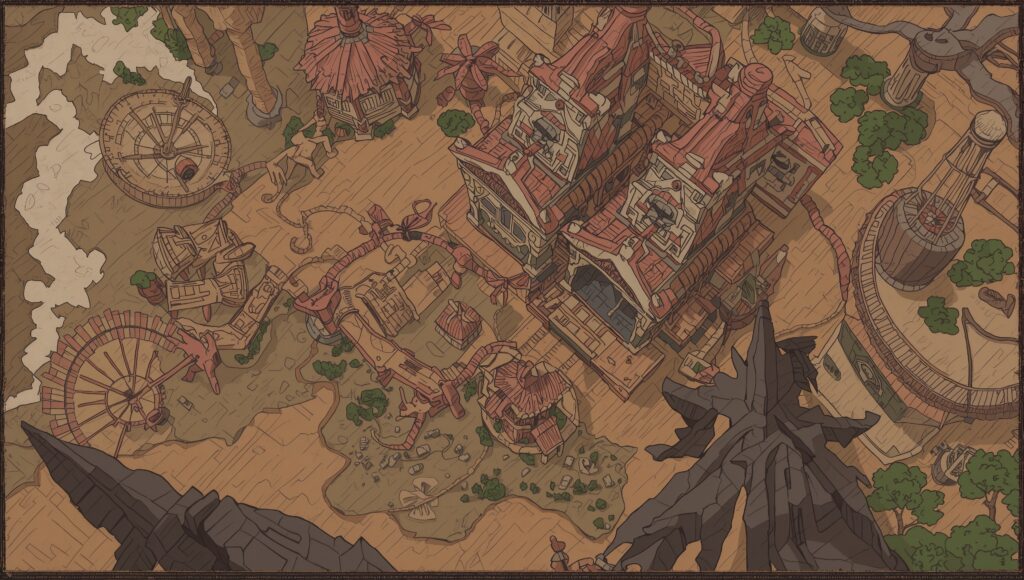
Image generated by Leonardo.Ai, 6 November 2025; prompt by me.
My work on and with generative AI continues apace, but I’m presently in a bit of a reflection and consolidation phase. One of the notions that’s popped up or out or through is that of generativity. Definitely not a dictionary word, but it emerged from — of all places — psychoanalysis. Specifically, it was used by a German-American psychoanalyst and artist named Erik Erikson. Erikson’s primary research focus was psychosocial development, and ‘generativity’ was the term he applied to “the concern in establishing and guiding the next generation” (source: p. 267).
My adoption of the term is in some ways adjacent, in the sense of a property of tools or systems that ‘help’ by generating choices, solutions, or possibilities. In this sense, generativity is also a practice and concept in and of itself. Generative artificial intelligence is, of course, one example of a technology possessing generativity, but I’ve also been thinking a lot about generative art (be it digital/code-based, or driven by analogue tools or naturally occurring randomness), generative design, procedural generation, mathematical/computational models of chance and probability, as well as lo-fi tools and processes: think dice, tarot cards, or roll tables in TTRPGs.
The name I’ve given my repeatable genAI experiments is ‘ritual-technic‘. These are designed specifically as recipes for generativity (one example here). Primarily, this is to allow some kind of exploration or understanding of the technology’s capabilities or limitations. They may also produce content that is useful: research fodder to unpack or analyse, or glitchy outputs that I can remix creatively. But another potential output is a protocol for generativity itself. One the one hand, these protocols can be rich in terms of understanding how LLMs conceive of creativity, human action, and the ‘real’ world. But on the other, they push users off the model, and into a generative mode themselves. These protocols are a kind of genAI costume you can put on, to try out being a generative thing yourself.
Another quality of the ritual-technic is that it will often test not just the machine, but the user. These are rituals, practices, bounded activities, that may occasion some strange feelings: uncertainty, confusion, delight, fear. These feelings shouldn’t be quashed or ignored, they should be observed, marked, noted, and tracked. Our subjective experience of using technology, particularly those like genAI that are opaque, complex, or ideologically-loaded, is the embodiment, the lived and felt experience, of our ethics and values. Many of my experiments have emerged as a way of learning about genAI in a way that feels engaging, relevant, and fun — yes! fun! what a concept! But as I’ve noted elsewhere, the feelings accompanying this work aren’t always comfortable. It’s always a reckoning: with my own creativity, capabilities, limitations, and with my willingness to accept assistance or outsource tasks to the unknown.
For Erikson, generativity was about nurturing the future. I think mine is more about figuring out what future we’re in, or what future I want to shape for myself. Part of this is finding ways to understand the systems that are influencing the world around us, and part of it is deciding when to take control, to accept control, or when to let it go. Generativity is, at least in my definition and understanding, innately about ceding some kind of control. You might be handing one of the reins to a D6 or a card draw, to a writing prompt or a creative recipe, or to a machine. In so doing, you open yourself to chance, to the unexpected, to the chaos, where fun or fear are just a coin flip away.
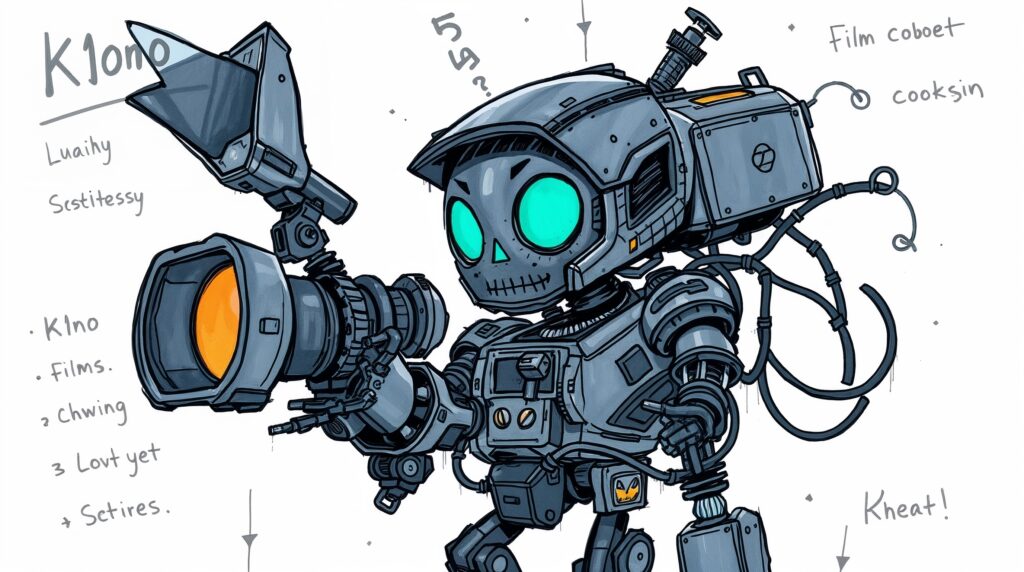
K1no looks… friendly. Image generated by Leonardo.Ai, 14 October 2025; prompt by me.
Notes from a GenAI Filmmaking Sprint
AI video swarms the internet. It’s been around for nearly as long as AI-generated images, however its recent leaps and bounds in terms of realism, efficiency, and continuity have made it a desirable medium for content farmers, slop-slingers, and experimentalists. That said, there are those who are deploying the newer tools to hint at new forms of media, narrative, and experience.
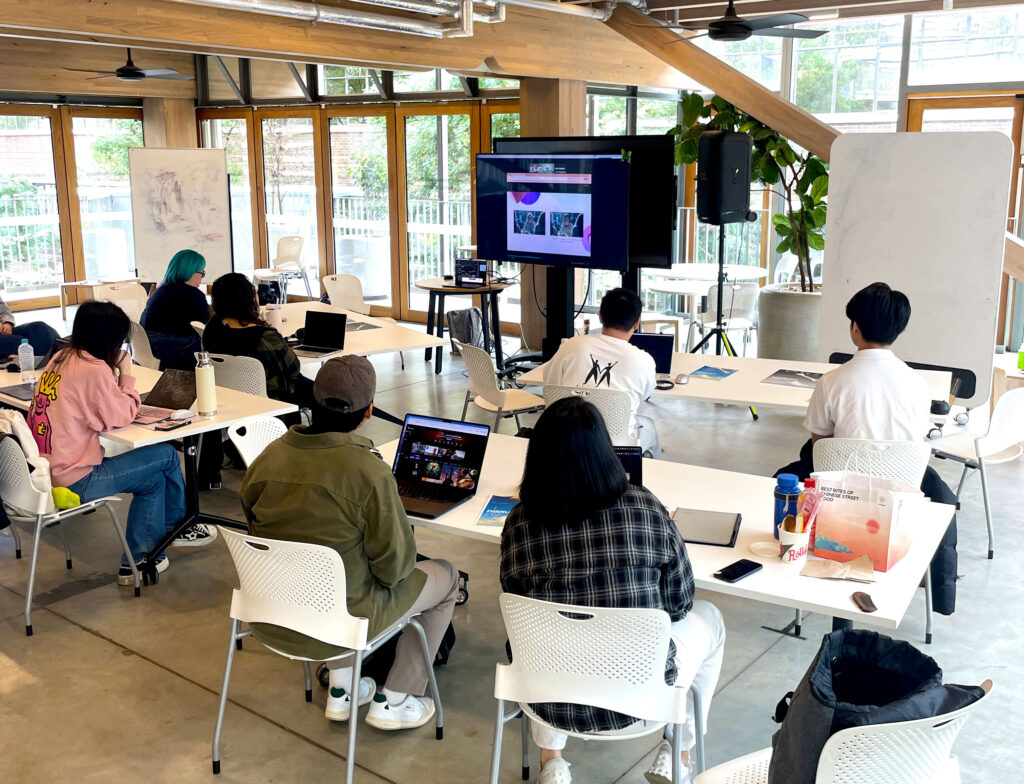
I was recently approached by the Disrupt AI Film Festival, which will run in Melbourne in November. As well as micro and short works (up to 3 mins and 3-15 mins respectively), they also have a student category in need of submissions. So over the last few weeks I organised a GenAI filmmaking Sprint at RMIT University last Friday. Leonardo.Ai was generous enough to donate a bunch of credits for us to play with, and also beamed in to give us a masterclass in how to prompt to generate AI video for storytelling — rather than just social media slurry.
Movie magic? Participants during the GenAI Filmmaking Sprint at RMIT University, 10 October 2025.
I also shared some thoughts from myresearch in terms of what kinds of stories or experiences work well for AI video, and also some practical insights on how to develop and ‘write’ AI films. The core of the workshop as a whole was to propose a structured approach: move from story ideas/fragments to logline, then to beat sheet, then shot list. The shot list, then, can be adapted slightly into the parlance of whatever tool you’re using to generate your images — you then end up with start frames for the AI video generator to use.
This structure from traditional filmmaking functions as a constraint. But with tools that can, in theory, make anything, constraints are needed more than ever. The results were glimpses of shots that embraced both the impossible, fantastical nature of AI video, while anchoring it with characters, direction, or a particular aesthetic.
In the workshop, I remembered moments in my studio Augmenting Creativity where students were tasked with using AI tools: particularly in the silences. Working with AI — even when it is dynamic, interesting, generative, fruitful, fun — is a solitary endeavour. AI filmmaking, too, in a sense, is a stark contrast to the hectic, chaotic, challenging, but highly dynamic and collaborative nature of real-life production. This was a reminder, and a timely one, that in teaching AI (as with any technology or tool), we must remember three turns that students must make: turn to the tool, turn to each other, turn to the class. These turns — and the attendant reflection, synthesis, and translation required with each — is where the learning and the magic happens.
This structured approach helpfully supported and reiterated some of my thoughts on the nature of AI collaboration itself. I’ve suggested previously that collaborating with AI means embracing various dynamics — agency, hallucination, recursion, fracture, ambience. This workshop moved away — notably, for me andmypredilections — from glitch, from fracture or breakage and recursion. Instead, the workflow suggested a more stable, more structured, more intentional approach, with much more agency on the part of the human in the process. The ambience, too, was notable, in how much time is required for the labour of both human and machine: the former in planning, prompting, managing shots and downloaded generations; the latter in processing the prompts, generating the outputs.
Video generated for my AI micro-film The Technician (2024).
What remains with me after this experience is a glimpse into creative genAI workflows that are more pragmatic, and integrated with other media and processes. Rather than, at best, unstructured open-ended ideation or, at worst, endless streams of slop, the tools produce what we require, and we use them to that end, and nothing beyond that. This might not be the radical revelation I’d hoped for, but it’s perhaps a more honest account of where AI filmmaking currently sits — somewhere between tool and medium, between constraint and possibility.