The Clockwork Penguin

Daniel Binns is a media theorist and filmmaker tinkering with the weird edges of technology, storytelling, and screen culture. He is the author of Material Media-Making in the Digital Age and currently writes about posthuman poetics, glitchy machines, and speculative media worlds.

Tag: publications

  • New research published: A media-materialist method for interpreting generative AI images

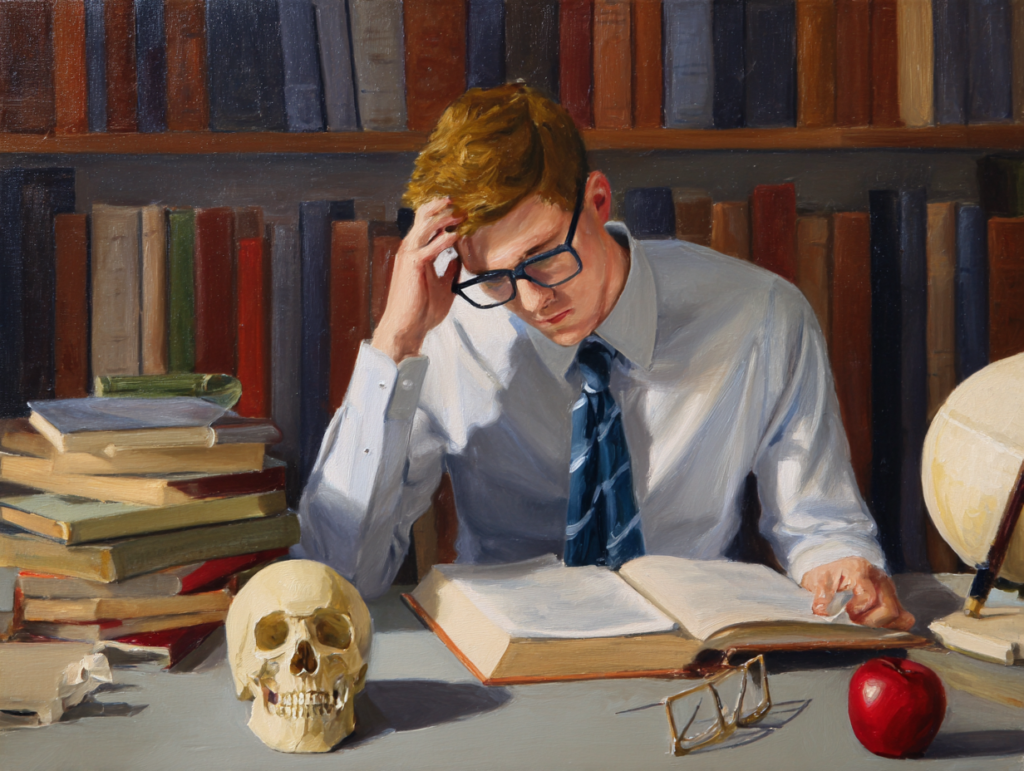
    One of the images I used in this article as a sample object of analysis. Generated in Midjourney using the prompt ‘intellectual rigor’. Perfectly reflects my state at various stages of this article’s composition and publication.

    After plenty of play and experimentation with AI imagery, I found myself reacting viscerally to commentary and early scholarship that was pejorative about — or outright dismissive of — these outputs. The prevailing discourse treated AI images as a kind of slop monolith, when I found a lot of my generations to be fascinating, disturbing, amusing, and even beautiful. In response, I wrote this article, which presents a four-layer method for a structured, formal analysis of AI-generated images. The four layers are data, model, interface, and prompt, reflecting the mechanisms of generative AI technology. Each layer offers various considerations and questions to ask about actual outputs, encouraging researchers, students, educators, and commentators to move beyond dismissing these images as mere slop, and to begin considering them as cultural artefacts.

    This piece is the foundation of all my work on genAI over the past two years (I hinted at its publication last year), and also the first where I’ve attempted to create a new method rather than just apply one. It’s also the first to really put forward my own take on media materialism, a philosophy and methodology that has guided my work for nearly ten years.

    I am a big believer in close analysis, be it of texts, imagery, video, films: all the objects of culture. But I struggled for a long time to bridge that method with a context that made sense to me. In figuring out that the mechanisms of making were another foundational aspect of my work, it took me a few pieces to be able to make this connection, i.e. what I’ve nearly always tried to do is to consider how the means of an object’s production leave their mark on the object itself. It’s a simple conclusion, but it’s taken several attempts for me to articulate it in a way that felt satisfactory. This article feels like the first to actually explain it appropriately; the next step is to deploy the approach across other kinds of synthetic media and generative systems more broadly, but also to possibly return with this approach to cinema and TV.

  • RIP Reviewer #2: Are All Peer Reviewers Dicks Now?

    Civility, care, and the ethics of critique in academia

    Here are some (lightly edited, anonymous) highlights from some recent peer review reports I received on submissions to Q1 journals.

    “a rather basic, limited and under-referenced overview”
    “I do not see how it contributes any original scholarship to the field”
    “The claim that [XYZ] is nonsense.”

    … and these weren’t even from Reviewer 2!

    Perhaps more distressingly, the following quote from an editor:

    “The paper might be interesting but is not well prepared, and not technically accurate or insightful, as revealed in biting commentary from the best of two reviews”

    The editor tries to be encouraging while also defending the same “biting commentary”:

    “Authors may take advantage of these excellent and insightful review comments, and possibly compose a new paper for a possible future submission”

    You may be thinking “Suck it up, snowflake.”

    Sorry but no.

    I’ve had harsh reviews before. I’ve written harsh reviews before. But you never call someone’s work ‘nonsense.’ You never call someone’s work ‘unoriginal’ or ‘basic’, even if you may think it. You certainly never do so without providing any suggestions as to how to redress these critiques, as these reviewers neglected to do.

    I might take about half an hour to write a blog post. Maybe up to a day or so if it’s a bit longer, needs some referencing, editing or proofing etc. I don’t really care if people don’t read or don’t like this work. It’s mainly for myself. However, the articles that these comments received took between four and twelve months to write: you expect some level of engagement and at least basic common human courtesy in how responses are framed.

    Reviewers: don’t be a dick.

    Editors: shield contributors from harsh reviews.

    Academia is intimidating and gatekept enough without this actual nonsense.

  • Material Media-Making is out (digitally) now

    The digital (PDF/EPUB) version of my new book Material Media-Making in the Digital Age is available now! Head to the Intellect site to purchase (or tell your institution’s library to do so!).

    Exciting!

    The cover of Material Media-Making in the Digital Age.

    From the blurb:

    “How might one craft a personal media-making practice that is thoughtful and considerate of the tools and materials at one’s disposal? This is the core question of this original new book. Exploring a number of media-making tools and processes like drones and vlogging, as well as thinking through time, editing, sound, and the stream, Binns looks out over the current media landscape in order to understand his own media practice.”