The Clockwork Penguin

Daniel Binns is a media theorist and filmmaker tinkering with the weird edges of technology, storytelling, and screen culture. He is the author of Material Media-Making in the Digital Age and currently writes about posthuman poetics, glitchy machines, and speculative media worlds.

Tag: social media

  • AI is a dirty word

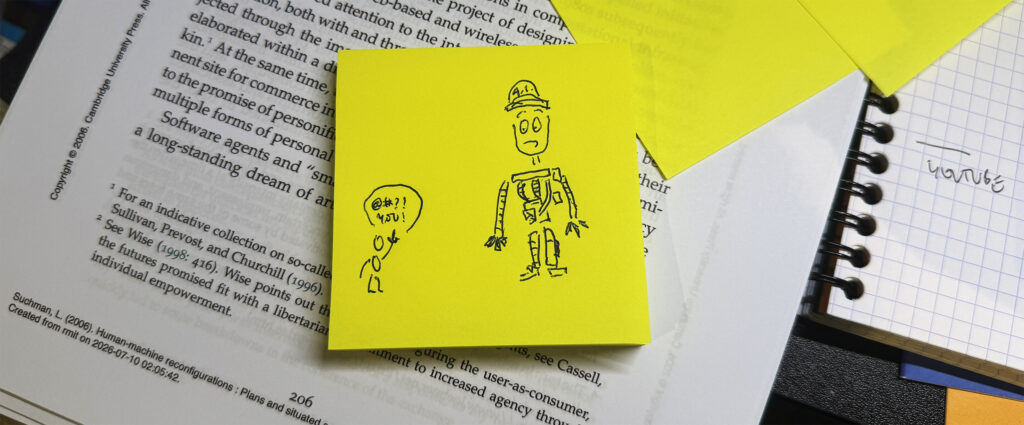
    Sketch by me. Originally I was going to crop the post-it out, but the accidental context couldn’t have been more perfect.

    Last week on LinkedIn, I posted this:

    Right now is a difficult time to be doing anything AI-related. The conversation has somehow polarised even further — and the extreme ends are doubling down in their zealotry. Being in the humanities means that I’m often surrounded by (well-meaning!) folx who are reluctant, if not downright hostile, to the technology and/or the corporate interests peddling the frontier versions of that technology.

    Reading social posts saying “if you engage with genAI you’re dead to me/an awful person” is difficult to take, particularly when I know some of those folx absolutely still use the tech to some degree behind the scenes (or are unaware of the embeddedness of other AI/ML technologies). I myself have been privately negotiating the line between creative misuse and active complicity since I started experimenting with genAI 3-4 years ago.

    But I still believe that fun and play are valid methods for critically interrogating how these technologies work, what they’re made of, and what they’re useful for or not. I am not ignorant: Big Tech ideology, environmental impacts, and IP concerns are very real. But there is a lack of basic understanding and literacy about these tools: absolutely not society’s fault, particularly when the media are completely clueless, and it’s in Big Tech’s interests to obfuscate the mechanisms of the machine. All of this means that fear and uncertainty dominate the conversation.

    My smol and weird AI work over the last few years has been technically challenging, ethically confronting, occasionally disturbing… but it has also been surprising, educational, sometimes delightful, useful, deeply weird (positively), and so much fun. Importantly, this work suggests alternatives to [gestures broadly] whatever this is. Fun, play, and mess are not just valid methods — I would argue that they’re more necessary than ever at a time when things feel like they’re out of our control.

    It got a handful of likes in the first couple of days, but over the last 24-48 hours I’ve seen engagement well beyond my network: likes and reactions, and comments from a few folx I don’t know. The long tail of LinkedIn posts about topical issues is perhaps something for another time and place (this post has nearly 3000 impressions at time of writing… like WTF??).

    The comments bear out what I suggest in the post: that opinions remain polarised, that people are skeptical, concerned, or on the flip side, excited or inspired.

    I left a great many things out of that post. It went through many, many drafts. I tossed up whether or not to post it at all. And I’ve gone through the wringer of emotional/psychological states as I’ve watched the reactions pile up.

    But as a creative, as a researcher, as a teacher and writer, I feel like I have to put myself out there in this way. Being scared of what people might think is a completely normal feeling; but using that as an excuse to not engage with the conversation, with other people, feels dishonest. It also means that my blog posts, newsletters, academic writing, sits in a bubble where others might not find it, or where it may be interpreted as volleys over the parapets without owning them or being accountable for them.

    Less drastically, perhaps, I’m genuinely interested in what others have to say. I’m at a stage in my life and career where I’m open to other perspectives, to having my views challenged, for others to pick up on my errors or foibles; before now, I was scared because I was just trying to figure out what on earth my values and opinions were at all.

    Sharing my work publicly, as it happens, is something that I really only began trying in earnest in 2025, mainly as a way to document my work and experiments with genAI. I’m still not remotely comfortable doing so. But it’s something I feel is really valuable, for me and, hopefully, for others.

  • Swings X Roundabouts

    Remember the good old days of social media, when we’d all sit around laughing at a Good Tweet™? Me either. Actually, that was never a thing. Photo by Anna Shvets on Pexels.

    Originally I was going to post some condensed form of this to socials, but I thought some may be interested in an extended ramble and/or the workflows involved.

    I deleted my Twitter last year in a mild fit of ethical superiority. I’d been on the platform some 14 years at that point. At first, I delighted in the novelty of microblogging; short little bursts of thought that people could read through, respond to, re-post themselves. But then, as is now de rigueur for all platforms, things changed. Even before Elon took over, the app started tweaking little bits and pieces, changing the way information was presented, prioritised, and delivered. Come the mid-2010s, it just wasn’t the same any more; by that stage, though, so many people that I knew and/or needed to know of, were using the app. It became something I checked weekly, like all my other social network pages, some blogs, etc. One more feed.

    Elon’s takeover, though, seemed like a fitting exit point. Many others felt the same way. I kind of rushed the breakaway, though; I did download all my data, thank the maker, but in terms of flagging the move with people who followed me for various reasons (personal, professional, tracking related declines, etc), I just… didn’t. I set up a Mastodon on the PKM instance, because that was a nice community that I’d found myself in as a positive byproduct of a rather all-encompassing obsession with productivity, life organisation, and information retention/recycling. I’m still on the ‘don (or Masta, per your preference), though I’ve shifted to the main mastodon.social instance to make automation and re-posting easier.

    Anyway, to cut to the quick, I rebooted the ol’ Twitter/X/Elon.com account in the last couple of months just to keep track of people who’ve not yet shifted elsewhere.1 What I didn’t manage to do before I shut it down last year, though, was to export/keep record of those 700 odd people I was following, nor did I just transfer them over to Mastodon, which tools like Movetodon allow you to do pretty seamlessly.

    Thankfully, buried in the data export was a JavaScript file called “following.js”, which contained IDs and URLs for all the Twitter accounts I’d originally followed. Bear in mind, though, not the Twitter usernames, e.g. @NY152 or @Shopgirl, but rather the ID number that Twitter creates as a stable reference for each user. The user IDs and URLs were also surrounded by all the JavaScript guff2 used to display the info in a readable form:

    {
    "following": {
    "accountId": "123456",
    "userLink": "https://twitter.com/intent/user?user_id=123456"
    }
    },
    {
    "following": {
    "accountId": "789012",
    "userLink": "https://twitter.com/intent/user?user_id=789012"
    }
    },
    {
    "following": {
    "accountId": "345678",
    "userLink": "https://twitter.com/intent/user?user_id=345678"
    }
    },

    I have a rudimentary grasp of very basic Python, but JavaScript remains beyond me, so I used the wonderful TextBuddy to remove everything but the URLs, then saved this as a text file. Though string manipulation is a wonderful process, unfortunately the checking of each account remains up to me.

    So whenever I have a spare hour, I’ve been sitting down at the computer and copying and pasting a bunch of URLs into the “Open Multiple URLs” Chrome extension. It’s tedious work, obviously. But it’s been really interesting to see a, who is inactive on Twitter and for how long they’ve been so; b, who’s switched to private since Elon or before; c, who’s moved to Masta or elsewhere; and d, who’s still active and how so. It’s also just a great chance to filter out all the rubbish accounts I followed over those fourteen years!

    In general terms, anyone with any level of tech knowledge or broad online following has shifted almost entirely to different services, maybe leaving up a link or a pinned post to catch any stray visitors. Probably around 40-50% of them are still active in some way; be that sharing work or thoughts with an established audience, or staying in touch with communities.3 Several of the URLs have hit 404s, which means that user has just deleted their X account entirely; good for you, even though I have no idea who you are/were!

    As I develop my thoughts around platforms, algorithms, culture, and so on, reflecting on my own platform use, tech setup, and engagements with data is becoming more than just a hobby; it’s forming a core part of the process. I’ve always struggled to rationalise the counting of my creative work and my personal interests/hobbies with my academic interests. But I think that from now on I just have to accept that there will always be overlap, particularly if I’m to do anything with these ideas, be it write a screenplay or a book, a bunch of blog posts, or anything academical.4


    Notes

    1. I also really like that I locked down the @binnsy username before anyone else got to it; there are plenty of Binnses even just in my family who use that nickname! ↩︎
    2. Guff is the technical term, obviously. ↩︎
    3. This is obviously prevalent in my field of academia, where so many supportive communities have been established over long periods of time, e.g. #PhDchat etc etc. I realised after I deleted my account that even though I don’t participate anywhere near like I used to, these are such valuable spaces when I do log on, and obviously for countless others. You don’t and can’t just throw that shit away. ↩︎
    4. You heard me. ↩︎
  • Push the button for a sweet treat

    I had grand plans of posting something about Godzilla today, but that will have to wait for these delightful rats. These tiny furry folx learned to associate pushing a little button with getting a sugar treat. As time progressed, though, they ended up just pushing the button for fun.

    The results are about as delightful as you’d expect.

    The project was led by French photographer Augustin Lignier, whose work explores the technography and performativity of photography. I came across the work due to the mighty Kottke, who quotes a New York Times piece where Lignier considers that the rats’ continued button-mashing as a neat analog for our addiction to social media.


    As platforms morph, shrink, converge, collapse all over the internet, one begins to wonder what the web of the imminent future might look like. While I did mention grassroots movements and community-run services like Neocities in my last post, the network effects that platforms like Substack, X, hell, even WordPress right here, can offer, are often more tempting than a cutesy throwback. That is to say nothing of the ease with which said platforms integrate with other services to maximise attention on their users.

    Substack and X are feeling the squeeze of the real world to greater and lesser degrees; the former as a safe space for Nazis, the latter as a haven for AI-generated deepfakes. But where one platform collapses, another will happily take its place, unless we all decide to opt out together.

    The internet of the future will be several interweaved different platforms, modes, nodes, devices, personalities, and communities. In a way it has always been so, but with its sheer ubiquity, the way it layers over and enfolds so many aspects of existence, thinking ‘the internet’ (or even ‘the Internet’, as autocorrect seemed to cling to forever) as a monolith is now a waste of time.

  • Critics and creation

    Photo by Leah Newhouse on Pexels.

    I started reading this interview this morning, between Anne Helen Peterson and Betsy Gaines Quammen. I still haven’t finished reading, despite being utterly fascinated, but even before I got to the guts of the interview, I was struck by a thought:

    In the algorithmised world, the creator is the critic.

    This thought is not necessarily happening in isolation; I’ve been thinking about ‘algorithmic culture’ for a couple of years, trying to order these thoughts into academic writing, or even creative writing. But this thought feels like a step in the right direction, even if I’ve no idea what the final output should or will be. Let’s scribble out some notes…

    If there’s someone whose work we enjoy, they’ll probably have an online presence — a blog or social media feed we can follow — where they’ll share what they like.

    It’s an organic kind of culture — but it’s one where the art and vocation of the critic continues to be minimised.

    This — and associated phenomena — is the subject of a whole bunch of recent and upcoming books (including this one, which is at the top of my to-read pile for the next month): a kind of culture where the all-powerful algorithm becomes the sole arbiter of taste, but I also think there is pressure on creatives to be their own kind of critical and cultural hub.

    On the inverse, what we may traditionally have called critics — so modern-day social media commentators, influencers, your Booktubers or Booktokkers, your video essayists and their ilk — now also feel pressure to create. This pressure will come from their followers and acolytes, but also from random people who encounter them online, who will say something like “if you know so much why don’t you just do it yourself” etc etc…

    Some critics will leap at the opportunity and they absolutely should — we are hearing from diverse voices that wouldn’t otherwise have thought to try.

    But some should leave the creation to others — not because they’re not worth hearing from, they absolutely are — but because their value, their creativity, their strength, lies in how they shape language, images, metaphor, around the work of others. They don’t realise — as I didn’t for a long time — that being a critic is a vocation, a life’s work, a real skill. Look at any longer-form piece in the London Review of Books or The New Inquiry and it becomes very clear how valuable this work is.

    I’ve always loved the term critic, particularly cultural critic, or commentator, or essayist… they always seemed like wonderful archaic terms that don’t belong in the modern, fragmented, divided, confused world. But to call oneself a critic or essayist, to own that, and only that, is to defy the norms of culture; to refuse the ‘pillars’ of novel, film, press/journalism, and to stand to one side, giving much-needed perspective to how these archaic forms define, reflect, and challenge society.

  • Shift Lock #3: A sales pitch for the tepid take

    After ‘abandoning’ the blog part of this site in early 2022, I embarked on a foolish newsletter endeavour called Shift Lock. It was fun and/or sustainable for a handful of posts, but then life got in the way. Over the next little while I’ll re-post those ruminations here for posterity. Errors and omissions my own. This instalment was published May 5, 2022 (see all Shift Lock posts here).


    Photo by Pixabay on Pexels.com

    Twitter was already a corporate entity, and had been struggling with how to market and position itself anyway. Not to mention, its free speech woes — irrevocably tied to those of its competitors — are not surprising. If anything, Mr. Musk was something of a golden ticket: someone to hand everything over to.

    The influx/exodus cycle started before the news was official… Muskovites joined/returned to Twitter in droves, opponents found scrolls bearing ancient Mastodon tutorials and set up their own mini-networks (let’s leave that irony steaming in the corner for now).

    None of this is new: businesses are bought and sold all the time, the right to free speech is never unconditional (and nor should it be), and the general populace move and shift and migrate betwixt different services, platforms, apps, and spaces all the time.

    What seems new, or at least different, about these latter media trends, issues, events, is the sheer volume of coverage they receive. What tends to happen with news from media industries (be they creative, social, or otherwise) is wall-to-wall coverage for a given week or two, before things peter out and we move on to the next block. It seems that online culture operates at two speeds: an instantaneous, rolling, roiling stream of chaos; and a broader, slightly slower rise and fall, where you can actually see trends come and go across a given time period. Taking the Oscars slap as an example: maybe that rise and fall lasts a week. Sometimes it might last two to four, as in the case of Musk and Twitter.

    How, then, do we consider or position these two speeds in broader ‘culture’?

    Like all of the aforementioned, Trump was not a new phenomenon. Populism was a tried and tested political strategy in 2015-16; just, admittedly, a strategy that many of us hoped had faded into obsolescence. However, true to the 20-30 year cycle of such things, Trump emerged. And while his wings were — mostly — clipped by the checks and balances of the over-complex American political system, the real legacy of his reign is our current post-truth moment. And that legacy is exemplified by a classic communications strategy: jamming. Jam the airwaves for a week, so everyone is talking about only one thing. Distract everyone from deeper issues that need work.

    This jamming doesn’t necessary come from politicians, from strategists, from agencies, as it may once have done. Rather, it comes from a conversational consensus emerging from platforms — and this consensus is most likely algorithmically-driven. That’s the real concern. And as much as Musk may want to open up the doors and release the code, it’s really not that straightforward.

    The algorithms behind social media platforms are complex — more than that, they are nested, like a kind of digital Rube Goldberg machine. People working on one section of the code are not aware nor comprehending of what other teams might be working on, beyond any do-not-disturb-type directives from on high. As scholar Nick Seaver says in a recent Washington Post piece, “The people inside Twitter want to understand how their algorithm works, too.” (Albergotti 2022)

    Algorithms — at least those employed by companies like Twitter — are built to stoke the fires of engagement. And there ain’t no gasoline like reactions, like outrage, like whatever the ‘big thing’ is for that particular week. These wildfires also intersect with the broader culture in ways that it takes longer-form criticism (I would say academic scholarship, but we often miss the mark, or more accurately, due to glacial peer review turnarounds, the boat) to meaningfully engage and understand.

    Thanks partly to COVID but also to general mental health stuff, I’ve been on a weird journey with social media (and news, to be fair) over the past 3-5 years. Occasional sabbaticals have certainly helped, but increasingly I’m just not checking it. This year I’ve found more and more writers and commentators whose long-form work I appreciate as a way of keeping across things, but also just for slightly more measured takes. Tepid takes. Not like a spa but more like a heated pool. This is partly why I started this newsletter-based journey, just to let myself think things through in a way that didn’t need to be posted immediately, but nor did I need to wait months/years for peer review. Somewhere beyond even the second trend-based speed I mentioned above.

    What it really lets me do, though, is disengage from the constant flow of algorithmically-driven media, opinion, reaction, and so on, in a way where I can still do that thinking in a relevant and appropriate way. What I’m hoping is that this kind of distance lets me turn around and observe that flow in new and interesting ways.


    Below the divider

    At the end of each post I link a few sites, posts, articles, videos that have piqued my interest of late. Some are connected to my research, some to teaching and other parts of academia, still others are… significantly less so (let’s keep some fun going, shall we?).


    Reed Albergotti (2022, 16 April), ‘Elon Musk wants Twitter’s algorithm to be public. It’s not that simple.’ Washington Post.