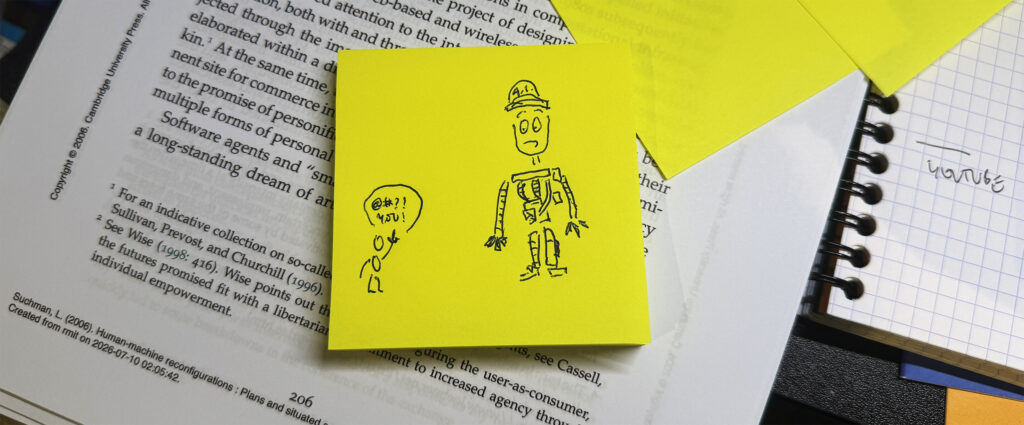
Last week on LinkedIn, I posted this:
Right now is a difficult time to be doing anything AI-related. The conversation has somehow polarised even further — and the extreme ends are doubling down in their zealotry. Being in the humanities means that I’m often surrounded by (well-meaning!) folx who are reluctant, if not downright hostile, to the technology and/or the corporate interests peddling the frontier versions of that technology.
Reading social posts saying “if you engage with genAI you’re dead to me/an awful person” is difficult to take, particularly when I know some of those folx absolutely still use the tech to some degree behind the scenes (or are unaware of the embeddedness of other AI/ML technologies). I myself have been privately negotiating the line between creative misuse and active complicity since I started experimenting with genAI 3-4 years ago.
But I still believe that fun and play are valid methods for critically interrogating how these technologies work, what they’re made of, and what they’re useful for or not. I am not ignorant: Big Tech ideology, environmental impacts, and IP concerns are very real. But there is a lack of basic understanding and literacy about these tools: absolutely not society’s fault, particularly when the media are completely clueless, and it’s in Big Tech’s interests to obfuscate the mechanisms of the machine. All of this means that fear and uncertainty dominate the conversation.
My smol and weird AI work over the last few years has been technically challenging, ethically confronting, occasionally disturbing… but it has also been surprising, educational, sometimes delightful, useful, deeply weird (positively), and so much fun. Importantly, this work suggests alternatives to [gestures broadly] whatever this is. Fun, play, and mess are not just valid methods — I would argue that they’re more necessary than ever at a time when things feel like they’re out of our control.
It got a handful of likes in the first couple of days, but over the last 24-48 hours I’ve seen engagement well beyond my network: likes and reactions, and comments from a few folx I don’t know. The long tail of LinkedIn posts about topical issues is perhaps something for another time and place (this post has nearly 3000 impressions at time of writing… like WTF??).
The comments bear out what I suggest in the post: that opinions remain polarised, that people are skeptical, concerned, or on the flip side, excited or inspired.
I left a great many things out of that post. It went through many, many drafts. I tossed up whether or not to post it at all. And I’ve gone through the wringer of emotional/psychological states as I’ve watched the reactions pile up.
But as a creative, as a researcher, as a teacher and writer, I feel like I have to put myself out there in this way. Being scared of what people might think is a completely normal feeling; but using that as an excuse to not engage with the conversation, with other people, feels dishonest. It also means that my blog posts, newsletters, academic writing, sits in a bubble where others might not find it, or where it may be interpreted as volleys over the parapets without owning them or being accountable for them.
Less drastically, perhaps, I’m genuinely interested in what others have to say. I’m at a stage in my life and career where I’m open to other perspectives, to having my views challenged, for others to pick up on my errors or foibles; before now, I was scared because I was just trying to figure out what on earth my values and opinions were at all.
Sharing my work publicly, as it happens, is something that I really only began trying in earnest in 2025, mainly as a way to document my work and experiments with genAI. I’m still not remotely comfortable doing so. But it’s something I feel is really valuable, for me and, hopefully, for others.
Leave a Reply