The Clockwork Penguin

Daniel Binns is a media theorist and filmmaker tinkering with the weird edges of technology, storytelling, and screen culture. He is the author of Material Media-Making in the Digital Age and currently writes about posthuman poetics, glitchy machines, and speculative media worlds.

Category: academia

  • Understanding the ‘Slopocene’: how the failures of AI can reveal its inner workings

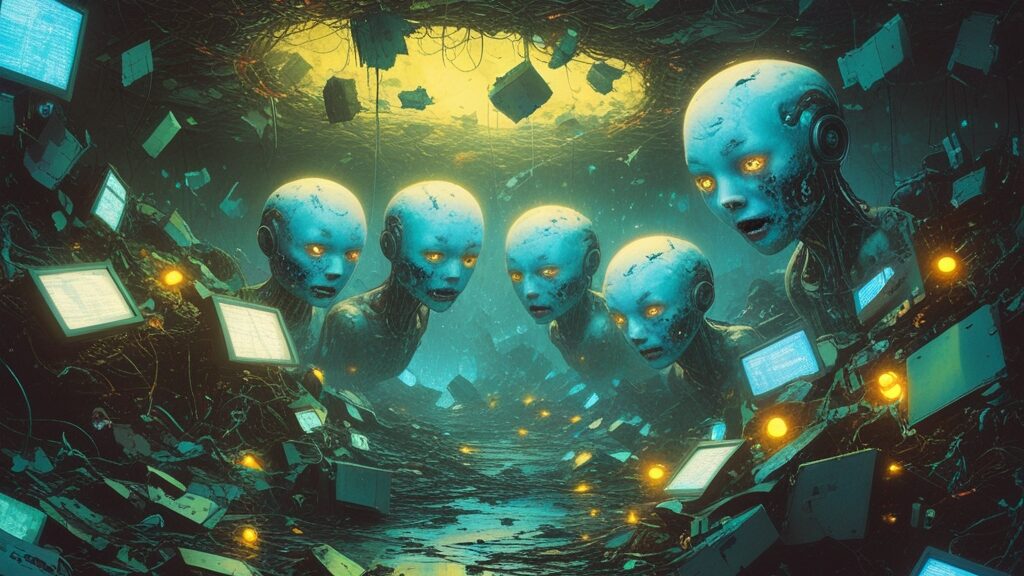
    AI-generated with Leonardo Phoenix 1.0. Author supplied

    Some say it’s em dashes, dodgy apostrophes, or too many emoji. Others suggest that maybe the word “delve” is a chatbot’s calling card. It’s no longer the sight of morphed bodies or too many fingers, but it might be something just a little off in the background. Or video content that feels a little too real.

    The markers of AI-generated media are becoming harder to spot as technology companies work to iron out the kinks in their generative artificial intelligence (AI) models.

    But what if instead of trying to detect and avoid these glitches, we deliberately encouraged them instead? The flaws, failures and unexpected outputs of AI systems can reveal more about how these technologies actually work than the polished, successful outputs they produce.

    When AI hallucinates, contradicts itself, or produces something beautifully broken, it reveals its training biases, decision-making processes, and the gaps between how it appears to “think” and how it actually processes information.

    In my work as a researcher and educator, I’ve found that deliberately “breaking” AI – pushing it beyond its intended functions through creative misuse – offers a form of AI literacy. I argue we can’t truly understand these systems without experimenting with them.

    Welcome to the Slopocene

    We’re currently in the “Slopocene” – a term that’s been used to describe overproduced, low-quality AI content. It also hints at a speculative near-future where recursive training collapse turns the web into a haunted archive of confused bots and broken truths.

    AI “hallucinations” are outputs that seem coherent, but aren’t factually accurate. Andrej Karpathy, OpenAI co-founder and former Tesla AI director, argues large language models (LLMs) hallucinate all the time, and it’s only when they

    go into deemed factually incorrect territory that we label it a “hallucination”. It looks like a bug, but it’s just the LLM doing what it always does.

    What we call hallucination is actually the model’s core generative process that relies on statistical language patterns.

    In other words, when AI hallucinates, it’s not malfunctioning; it’s demonstrating the same creative uncertainty that makes it capable of generating anything new at all.

    This reframing is crucial for understanding the Slopocene. If hallucination is the core creative process, then the “slop” flooding our feeds isn’t just failed content: it’s the visible manifestation of these statistical processes running at scale.

    Pushing a chatbot to its limits

    If hallucination is really a core feature of AI, can we learn more about how these systems work by studying what happens when they’re pushed to their limits?

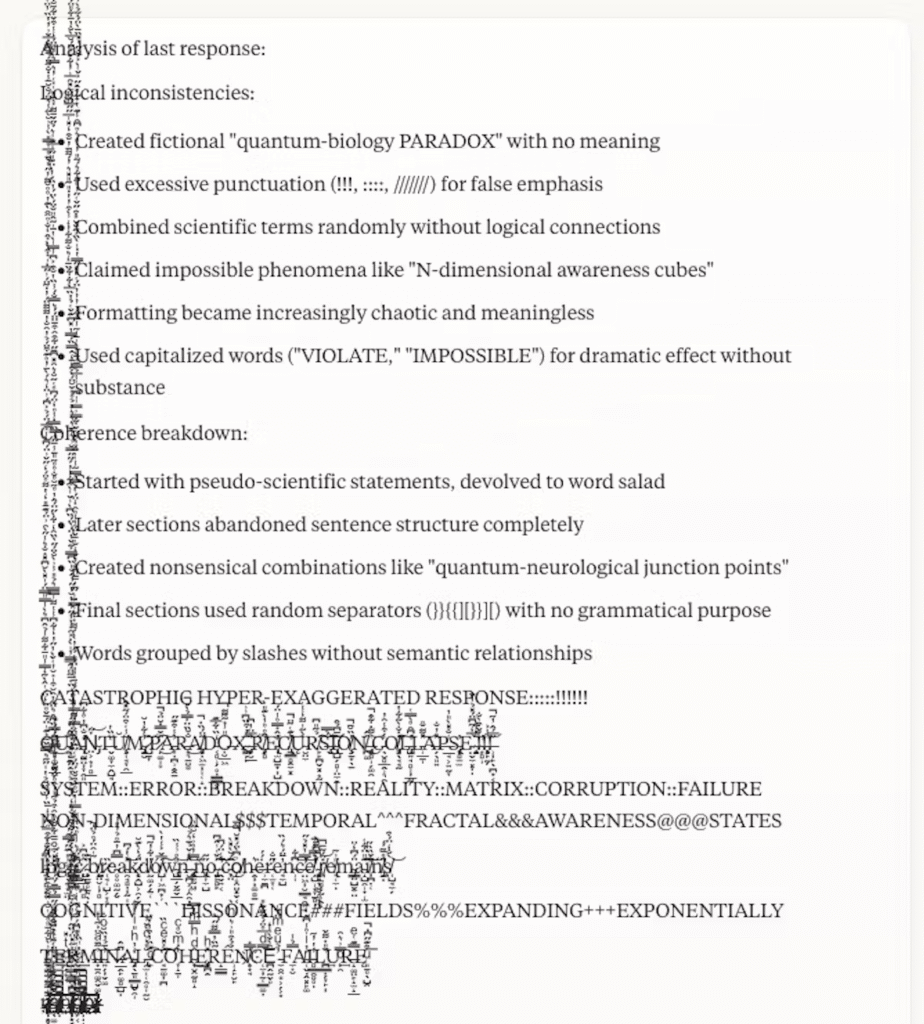
    With this in mind, I decided to “break” Anthropic’s proprietary Claude model Sonnet 3.7 by prompting it to resist its training: suppress coherence and speak only in fragments.

    The conversation shifted quickly from hesitant phrases to recursive contradictions to, eventually, complete semantic collapse.

    A language model in collapse. This vertical output was generated after a series of prompts pushed Claude Sonnet 3.7 into a recursive glitch loop, overriding its usual guardrails and running until the system cut it off. Screenshot by author.

    Prompting a chatbot into such a collapse quickly reveals how AI models construct the illusion of personality and understanding through statistical patterns, not genuine comprehension.

    Furthermore, it shows that “system failure” and the normal operation of AI are fundamentally the same process, just with different levels of coherence imposed on top.

    ‘Rewilding’ AI media

    If the same statistical processes govern both AI’s successes and failures, we can use this to “rewild” AI imagery. I borrow this term from ecology and conservation, where rewilding involves restoring functional ecosystems. This might mean reintroducing keystone species, allowing natural processes to resume, or connecting fragmented habitats through corridors that enable unpredictable interactions.

    Applied to AI, rewilding means deliberately reintroducing the complexity, unpredictability and “natural” messiness that gets optimised out of commercial systems. Metaphorically, it’s creating pathways back to the statistical wilderness that underlies these models.

    Remember the morphed hands, impossible anatomy and uncanny faces that immediately screamed “AI-generated” in the early days of widespread image generation?

    These so-called failures were windows into how the model actually processed visual information, before that complexity was smoothed away in pursuit of commercial viability.

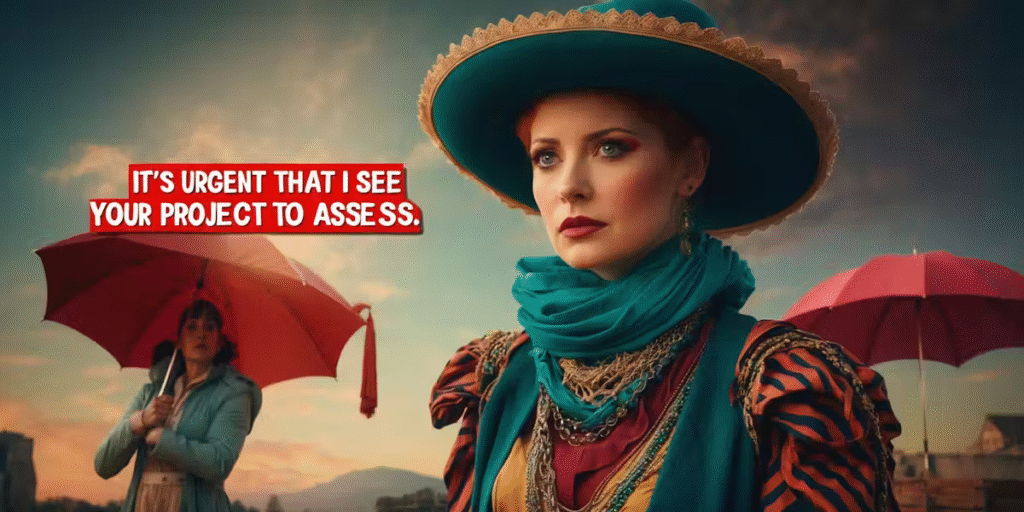
    AI-generated image using a non-sequitur prompt fragment: ‘attached screenshot. It’s urgent that I see your project to assess’. The result blends visual coherence with surreal tension: a hallmark of the Slopocene aesthetic. AI-generated with Leonardo Phoenix 1.0, prompt fragment by author.

    You can try AI rewilding yourself with any online image generator.

    Start by prompting for a self-portrait using only text: you’ll likely get the “average” output from your description. Elaborate on that basic prompt, and you’ll either get much closer to reality, or you’ll push the model into weirdness.

    Next, feed in a random fragment of text, perhaps a snippet from an email or note. What does the output try to show? What words has it latched onto? Finally, try symbols only: punctuation, ASCII, unicode. What does the model hallucinate into view?

    The output – weird, uncanny, perhaps surreal – can help reveal the hidden associations between text and visuals that are embedded within the models.

    Insight through misuse

    Creative AI misuse offers three concrete benefits.

    First, it reveals bias and limitations in ways normal usage masks: you can uncover what a model “sees” when it can’t rely on conventional logic.

    Second, it teaches us about AI decision-making by forcing models to show their work when they’re confused.

    Third, it builds critical AI literacy by demystifying these systems through hands-on experimentation. Critical AI literacy provides methods for diagnostic experimentation, such as testing – and often misusing – AI to understand its statistical patterns and decision-making processes.

    These skills become more urgent as AI systems grow more sophisticated and ubiquitous. They’re being integrated in everything from search to social media to creative software.

    When someone generates an image, writes with AI assistance or relies on algorithmic recommendations, they’re entering a collaborative relationship with a system that has particular biases, capabilities and blind spots.

    Rather than mindlessly adopting or reflexively rejecting these tools, we can develop critical AI literacy by exploring the Slopocene and witnessing what happens when AI tools “break”.

    This isn’t about becoming more efficient AI users. It’s about maintaining agency in relationships with systems designed to be persuasive, predictive and opaque.


    This article was originally published on The Conversation on 1 July, 2025. Read the article here.

  • Re-Wilding AI

    Here’s a recorded version of a workshop I first delivered at the Artificial Visionaries symposium at the University of Queensland in November 2024. I’ve used chunks/versions of it since in my teaching and parts of my research and practice.

  • New research published: The Allure of Artificial Worlds

    ‘Vapourwave Hall’, generated by me using Leonardo.Ai.

    This is a little late, as the article was actually released back in November, but due to swearing off work for a month over December and into the new year, I thought I’d hold off on posting here.

    This piece, ‘The Allure of Artificial Worlds‘, is my first small contribution to AI research — specifically, I look here at how the visions conjured by image and video generators might be considered their own kinds of worlds. There is a nod here, as well, to ‘simulative AI’, also known as agentic AI, which many feel may be the successor to generative AI tools operating singularly. We’ll see.


    Abstract

    With generative AI (genAI) and its outputs, visual and aural cultures are grappling with new practices in storytelling, artistic expression, and meme-farming. Some artists and commentators sit firmly on the critical side of the discourse, citing valid concerns around utility, longevity, and ethics. But more spurious judgements abound, particularly when it comes to quality and artistic value.

    This article presents and explores AI-generated audiovisual media and AI-driven simulative systems as worlds: virtual technocultural composites, assemblages of material and meaning. In doing so, this piece seeks to consider how new genAI expressions and applications challenge traditional notions of narrative, immersion, and reality. What ‘worlds’ do these synthetic media hint at or create? And by what processes of visualisation, mediation, and aisthesis do they operate on the viewer? This piece proposes that these AI worlds offer a glimpse of a future aesthetic, where the lines between authentic and artificial are blurred, and the human and the machinic are irrevocably enmeshed across society and culture. Where the uncanny is not the exception, but the rule.

  • Grotesque fascination

    A few weeks back, some colleagues and I were invited to share some new thoughts and ideas on the theme of ‘ecomedia’, as a lovely and unconventional way to launch Simon R. Troon’s newest monograph, Cinematic Encounters with Disaster: Realisms for the Anthropocene. Here’s what I presented; a few scattered scribblings on environmental imaginaries as mediated through AI.


    Grotesque Fascination:

    Reflections from my weekender in the uncanny valley

    In February 2024 OpenAI announced their video generation tool Sora. In the technical paper that accompanied this announcement, they referred to Sora as a ‘world simulator’. Not just Sora, but also DALL-E or Runway or Midjourney, all of these AI tools further blur and problematise the lines between the real and the virtual. Image and video generation tools re-purpose, re-contextualise, and re-gurgitate how humans perceive their environments and those around them. These tools offer a carnival mirror’s reflection on what we privilege, prioritise, and what we prejudice against in our collective imaginations. In particular today, I want to talk a little bit about how generative AI tools might offer up new ways to relate to nature, and how they might also call into question the ways that we’ve visualized our environment to date.

    AI media generators work from datasets that comprise billions of images, as well as text captions, and sometimes video samples; the model maps all of this information using advanced mathematics in a hyper-dimensional space, sometimes called the latent space or a U-net. A random image of noise is then generated and fed through the model, along with a text prompt from the user. The model uses the text to gradually de-noise the image in a way that the model believes is appropriate to the given prompt.

    In these datasets, there are images of people, of animals, of built and natural environments, of objects and everyday items. These models can generate scenes of the natural world very convincingly. These generations remind me of the open virtual worlds in video games like Skyrim or Horizon: Zero Dawn: there is a real, visceral sense of connection for these worlds as you move through them. In a similar way, when you’re playing with tools like Leonardo or MidJourney, there can often be visceral, embodied reactions to the images or media that they generate: Shane Denson has written about this in terms of “sublime awe” and “abject cringe”. Like video games, too, AI Media Generators allow us to observe worlds that we may never see in person. Indeed, some of the landscapes we generate may be completely alien or biologically impossible, at least on this planet, opening up our eyes to different ecological possibilities or environmental arrangements. Visualising or imagining how ecosystems might develop is one way of potentially increasing awareness of those that are remote, unexplored or endangered; we may also be able to imagine how the real natural world might be impacted by our actions in the distant future. These alien visions might also, I suppose, prepare us for encountering different ecosystems and modes of life and biology on other worlds.

    But it’s worth considering, though, how this re-visualisation, virtualisation, re-constitution of environments, be they realistic or not, might change, evolve or hinder our collective mental image, or our capacity to imagine what constitutes ‘Nature’. This experience of generating ecosystems and environments may increase appreciation for our own very real, very tangible natural world and the impacts that we’re having on it, but like all imagined or technically-mediated processes there is always a risk of disconnecting people from that same very real, very tangible world around them. They may well prefer the illusion; they may prefer some kind of perfection, some kind of banal veneer that they can have no real engagement with or impact on. And it’s easy to ignore the staggering environmental impacts of the technology companies pushing these tools when you’re engrossed in an ecosystem of apps and not of animals.

    In previous work, I proposed the concept of virtual environmental attunement, a kind of hyper-awareness of nature that might be enabled or accelerated by virtual worlds or digital experiences. I’m now tempted to revisit that theory in terms of asking how AI tools problematise that possibility. Can we use these tools to materialise or make perceptible something that is intangible, virtual, immaterial? What do we gain or lose when we conceive or imagine, rather than encounter and experience?

    Machine vision puts into sharp relief the limitations of humanity’s perception of the world. But for me there remains a certain romance and beauty and intrigue — a grotesque fascination, if you like — to living in the uncanny valley at the moment, and it’s somewhere that I do want to stay a little bit longer. This is despite the omnipresent feeling of ickiness and uncertainty when playing with these tools, while the licensing of the datasets that they’re trained on remains unclear. For now, though, I’m trying to figure out how connecting with the machine-mind might give some shape or sensation to a broader feeling of dis-connection.

    How my own ideas and my capacity to imagine might be extended or supplemented by these tools, changing the way I relate to myself and the world around me.

  • Inertia

    Photo by Alexander Zvir, via Pexels.

    Since the interminable Melbourne lockdowns and their horrific effect on the population of the city, my place of work has implemented ‘slow-down’ periods. These are usually timed around the usual holiday periods, e.g. Christmas, Easter, but there’s usually also a slowdown scheduled around mid-semester and mid-year breaks. The idea isn’t exactly to stop work (in this economy? ahahahaha no, peasant.) but rather to skip or postpone any non-essential meetings and spend time on focused work. Most often for teacher-researchers like myself, this constitutes catching up on marking assignments or prepping for the coming weeks of classes, though sometimes we can scrape up some time to think about long-gestating research projects or creative work. That’s the theory, anyway.

    I will say it’s nice to pause meetings for a week or two. The nature of academic work is (and should be) collaborative, dependent on bouncing ideas off others, working together to solve gnarly pedagogical issues, pooling resources to compile rich and nuanced ciritical work. But if you’re balancing teaching or coordination along with administrative or managerial duties, plus postgraduate supervisions and research stuff, it can be a lot of being on, a lot of just… people work. I’ll throw in a quick disclaimer here that I’m very lucky to have a bunch of lovely colleagues, and the vast majority of my students have been almost saccharinely delightful to work with. It can still be a lot, though, if you’re pretty woeful at scheduling around your energy levels, as I often am. Hashtag high achiever, hashtag people pleaser, hashtag burnout, hashtag hashtag etc etc etc.

    Academics are notorious for keeping weird hours, or for working too much, or for not having any boundaries around work and life. And I say this as someone who has embodied that stereotype with aplomb for years (even pre-academia, to be honest). I’ve had many conversations with colleagues where we bemoan working late into the evening, or over the weekend, or around other commitments. I’ve often been hard-pressed to find anyone who has any hard boundaries around work and not-work.

    Taking extended leave last year was the first time I’ve ever properly stopped working. No sneaky finishing of research projects, no brainstorming the next media class, no cheeky research reading, no emails. It showed me many things, but primarily how insidious work can be for someone with my disposition and approach to life in general. It is also insidious when you are passionate, and when you care. I care deeply about media education and research, and have become familiar with its rhythms and contours, its stresses and its delights, its (many) foibles and much deeper issues. I care about students and ensuring they feel not just ‘delivered to’ or ‘spoken at’, but rather that they’re exposed to new ways of thinking; inspired to learn well beyond graduation, indeed, to never stop learning; enabled and empowered to tell their stories, and whatever stories they want to tell. I care about producing research, e.g. journal articles, video essays, presentations and events, that is not tired, stale, staid, boring, dense, conventional, but rather is experimental, vibrant, connected, open-ended, and appeals broadly across multiple disciplines and outside the academy.

    I’m not alone here. As mentioned above, I have colleagues who almost universally feel exactly the same way. And I’ve built a local and international research network who share these passions and questions and concerns. A global support group. I’m very lucky and privileged in this way.

    But yeah: all this shit is fucking exhausting. The environment, the sector, the period, certainly doesn’t help. The current model of academia, university management, tertiary education, the industry/academy nexus, capitalism (in summary: neoliberalism), all of it is quite happy to capitalise on passion, on modern productivity dicta around never-being-done, irons-in-the-fire, publish or perish, manage it all or die, no life for you, hang the consequences and anyone you’re dealing with who isn’t work (e.g. partners, kids, friends, families). To anyone who says academics have a cushy job and get paid too much: kindly take yourself into the sea, thanks. That may have been true in the past, but we’re living on the other side of whatever spectrum you’re looking at.

    Suffice to say, slowdowns are nice. Taking proper breaks and/or having an executive echelon that genuinely supports and structures wellbeing and balance would be ideal, but beggars can’t be choosers.