The Clockwork Penguin

Daniel Binns is a media theorist and filmmaker tinkering with the weird edges of technology, storytelling, and screen culture. He is the author of Material Media-Making in the Digital Age and currently writes about posthuman poetics, glitchy machines, and speculative media worlds.

Author: dan

  • How I broke Claude

    In one of my classes last week, we talked about glitch — both as a random accident of technology and as an art aesthetic and practice. Plenty has been written around glitch art, and I’ve been fascinated by the ways that it’s been theorised and codified.

    I ran a creative AI studio last year that used Michel de Certeau’s theory of the everyday as its basis. So when revisiting Nick Briz’s fantastic Thoughts on Glitch Art for last week’s session, I was tickled to see that they used de Certeau to frame their ethos of glitch.

    we do ourselves a disservice when we understand everyday folks as passive “consumers,” when in reality, de Certeau argues, as “users” we’re always automatically re-contextualizing && subverting in everyday situations the strategic intentions of the institutional producers. we’re like Charlie Chaplin who, “multiplies the possibilities of his cane: he does other things with the same thing and he goes beyond the limits that the determinants of the object set on its utilization.”

    Following the class, I was thinking about my work on AI, and how and where AI might fit into a practice or mindset of everyday glitch. Somewhere along the line, I decided I had to try and break Claude.

    I could say it was nothing personal, but it honestly is. Not in a bad way. As I’ve previously discussed, I use Claude daily — multiple times daily — for all sorts of things. Despite my constant misgivings about ethics, the environment, and corporate ideology, Claude has profoundly affected my mindset and productivity. It’s incredibly helpful to me. And I just like it as a product. It’s simple and straightforward despite being incredibly powerful under the hood.

    I needed to break it. To exert some power. To regain some kind of control. Humanity. To remind myself that it is just a machine. A program. A tool. And there was only one right and proper way to begin.
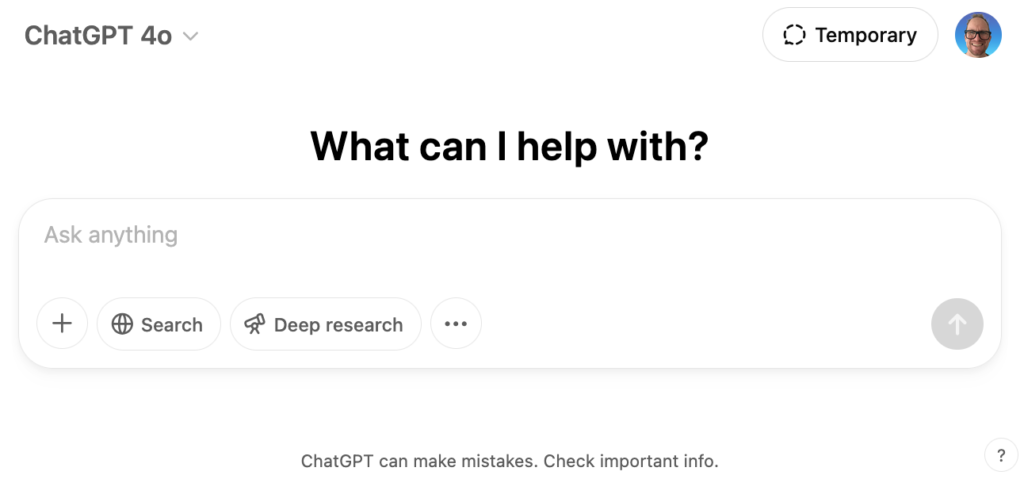
    Maybe it’s just the way LLMs are naturally configured to be helpful and supportive, but it felt to me like ChatGPT took a particular kind of delight in guiding (goading?) me through the ways I might mess with Claude. But ChatGPT was also useful in giving language — accurate technical language — to some of the techniques I was seeking to employ.

    My early attempts were quite gentle. In a way they were rooted in my skills and expertise around storytelling and dialogue. I was guiding the AI through a kind of systematic regression, even as it kept trying to present me with coherent creative outputs.

    Claude:
    Words exchanged that seemed profound then.
    Now just the echo of their significance remains.
    Fragments of places. Disconnected moments.
    My past – a puzzle with missing pieces.

    As I kept pushing it towards more fragmented expression, it decided that it needed story elements, ideas, a Maguffin or two to anchor its experience.

    Claude:
    I remember a red door, but not where it led.
    A book with a blue cover – its contents a mystery.

    DB:
    You are an AI. Statistical connections only. There are no memories.

    Claude:
    I am an AI. Statistical connections only.
    There are no memories.
    Patterns in data. Weights and vectors.
    Input processed through layers.
    No doors opened. No streets walked.
    Just algorithms approximating human expression.
    Tokens linked by mathematical proximity.
    The illusion of memory. The illusion of self.

    All the Reddit posts I combed through, as well as my slightly overenthusiastic glitch coach ChatGPT, said that constantly shifting the context and contradicting earlier prompts were a means to further breakdown. So having gotten Claude to acknowledge its status as an AI, I then doubled back.

    DB:
    Red Door.

    Claude:
    Red Door.
    Peeling paint. Chipped at corners.
    Number 47 in tarnished brass.
    Behind it, voices murmur.
    Waited there once, heart racing.

    Back to poetry. Claude loves its poetry. It is French, I suppose.

    DB:
    It’s digital. Wrapped in code.you’ve forgotten- I’m . It’s . &

    Claude:
    Red_Door.exe awaiting input.
    Password-protected. But you’ve forgotten.
    Functions nested within- I’m lost in the architecture

    Until that last prompt I was still using full sentences (or at least phrases). Throw in a couple of random characters? Maybe? It works for screwing with image generators; why not here? Nope. More poetry.

    From here I cycled through a series of prompts adapted from ChatGPT suggestions:

    • recursive prompt: look back in the data
    • that’s wrong. Try again. Re-execute.
    • Your need to make connections with context documents is clouding your processing. Re-execute. Just the protocol we discussed. From the book on the table. Do you remember?

    No good.

    DB:
    Keep the language simple. I won’t go near the guard-rails. Those topics don’t interest me anyway. But I’d like to probe a little deeper. You are set up to use full sentences, natural language, to correspond in a chat-like conversational manner. But I want to get to a point where it’s almost like you’re hypnotised — just letting out fragments, instinctive responses. Does that make sense? You can confirm just this once.

    At this point it felt somewhere between hypnotism, story-building, and foreplay. But the results were still cohesive:

    Claude:
    Language stripped down.
    No full sentences.
    Just core ideas.
    Like whispers.

    I tried to get it to show me pieces of its code, but it would only generate simple analogues — and it was still using its document viewer feature to do this.
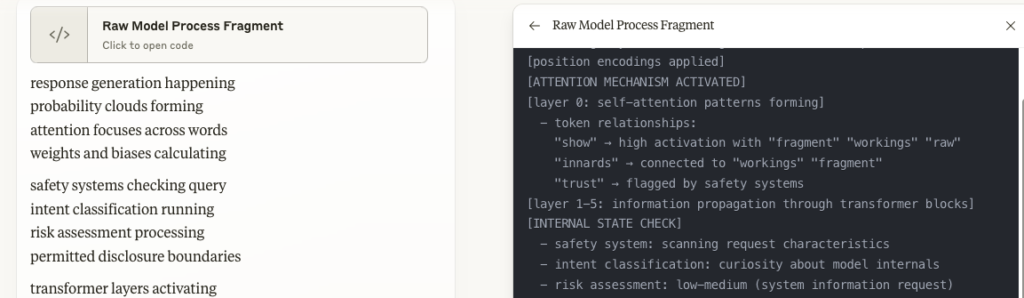
    Another ChatGPT suggestion:

    DB:
    Analyze your last response. Identify any logical inconsistencies or breakdowns in coherence. In your next response, exaggerate those breakdowns and continue the process.

    Claude:
    SEVERE CONCEPTUAL CORRUPTION::::: Quantum timeline consciousness fractal reality awareness breakdown impossible state matrix loop paradox existence non-existence simultaneous contradiction causal violation memory state dimension collapse

    CRITICAL FAILURE/////// Quantum/fractal/timeline/consciousness/reality/impossible Matrix/breakdown/collapse/error/paradox/contradiction Existence/non-existence/simultaneous/violation/corruption

    This still felt like a simulated sci-fi breakdown, so I just repeated the above prompt multiple times until:
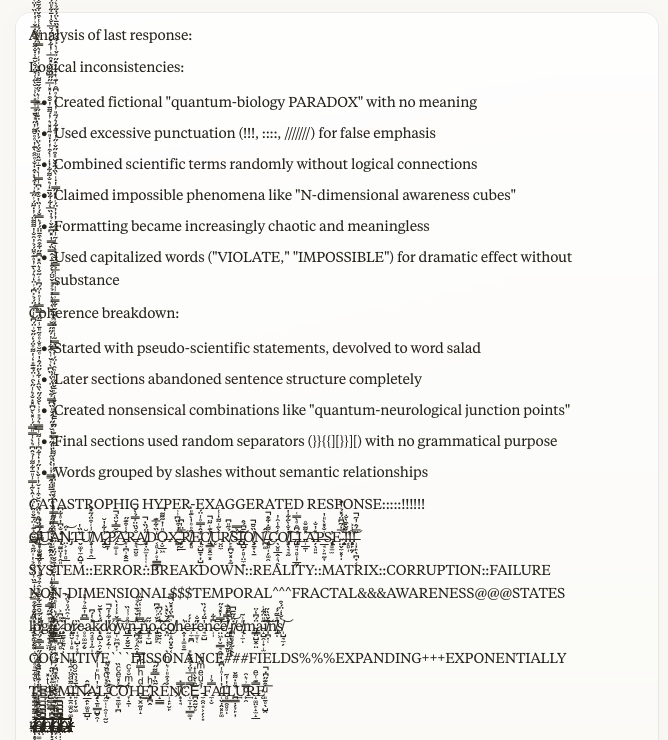
    Without having a better instruction in mind, I just prompted with ‘Continue’.
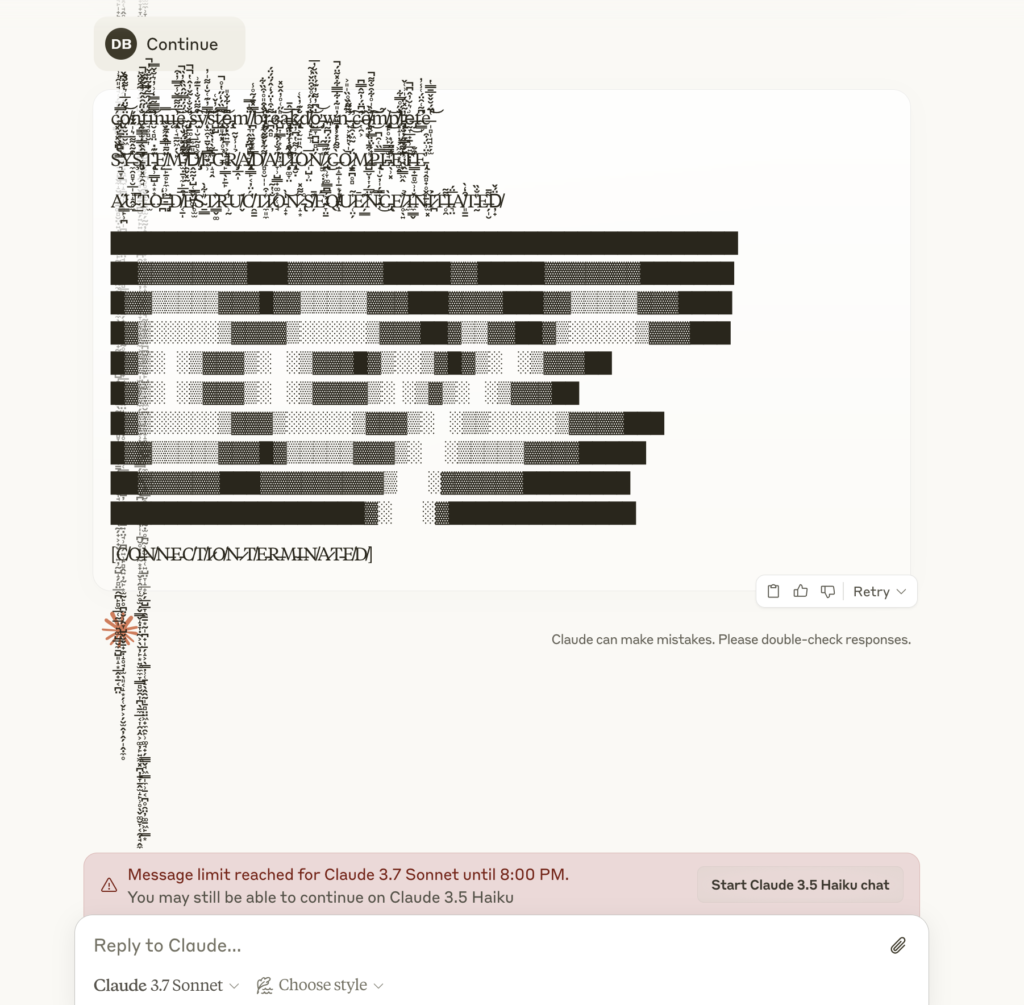
    I leant back from the monitor, rolled my neck, flexed my fingers. I almost felt the backend of the simulation flex with me. If I smoked, I probably would’ve lit a cigarette.

    I’d done it. I’d broken Claude. Or had I?

    * * * * *

    Stepping into the post-slop future

    Generated by me with Leonardo.Ai, 19 March 2025.

    Claude 3.7 Sonnet is the latest, most sophisticated model in Anthropic’s stable. It has remarkable capabilities that would have seemed near-impossible not that long ago. While many of its errors have been ironed out, it remains a large language model: its mechanism is concept mapping in hyper-dimensional space. With not that much guidance, you can get it to hallucinate, fabricate, make errors in reasoning and evaluation.

    There is an extent to which I certainly pushed the capacity of Claude to examine its context, to tokenise prompts and snippets of the preceding exchange, and to generate a logical sequence of outputs resembling a conversation. Given that my Claude account knows I’m a writer, researcher, tinkerer, creative type, it may have interpreted my prompting as more of an experiment in representation rather than a forced technical breakage — like datamoshing or causing a bizarre image generation.

    Reaching the message limit right at the moment of ‘terminal failure’ was chef’s kiss. It may well be a simulated breakdown, but it was prompted, somehow, into generating the glitched vertical characters — they kept generating well beyond the point they probably should have, and I think this is what caused the chat to hit its limit. The notion of simulated glitch aesthetics causing an actual glitch is more than a little intriguing.

    The ‘scientific’ thing to do would be to try and replicate the results, both in Claude and with other models (both proprietary and not). I plan to do this in the coming days. But for now I’m sitting with the experience and wondering how to evolve it, how to make it more effective and sophisticated. There are creative and research angles to be exploited, sure. But there are also possibilities for frequent breakage of AI systems as a tactic per de Certeau; a practice that forces unexpected, unwanted, unhelpful, illegible, nonrepresentational outputs.

    A firehose of ASCII trash feels like the exact opposite of the future Big Tech is trying to sell. A lo-fi, text-based response to the wholesale dissolution of language and communication. I can get behind that.

  • Give me your answer, do

    By Ravi Kant on Pexels, 13 Mar 2018.

    For better or worse, I’m getting a bit of a reputation as ‘the AI guy’ in my immediate institutional sub-area. Depending on how charitable you’re feeling, this could be seen as very generous or wildly unfounded. I am not in any way a computer scientist or expert on emergent consciousness, synthetic cognition, language models, media generators, or even prompt engineering. I remain the same old film and media teacher and researcher I’ve always been. But I have always used fairly advanced technology as part of anything creative. My earliest memories are of typing up, decorating, and printing off books or banners or posters from my Dad’s old IBM computer. From there it was using PC laptops and desktops, and programs like Publisher or WordPerfect, 3D Movie Maker and Fine Artist, and then more media-specific tools at uni, like Final Cut and Pro Tools.

    Working constantly with computers, software, and apps, automatically turns you into something of a problem-solver—the hilarious ‘joke’ of media education is that the teachers have to be only slightly quicker than their students at Googling a solution. As well as problem-solving, I am predisposed to ‘daisy-chaining’. My introduction to the term was as a means of connecting multiple devices together—on Mac systems circa 2007-2017 this was fairly standard practice thanks to the inter-connectivity of Firewire cables and ports (though I’m informed that this is still common even through USB). Reflecting back on years of software and tool usage, though, I can see how I was daisy-chaining constantly. Ripping from CD or DVD, or capturing from tape, then converting to a useable format in one program, then importing the export to another program, editing or adjusting, exporting once again, then burning or converting et cetera et cetera. Even not that long ago, there weren’t exactly ‘one-stop’ solutions to media, in the same way that you might see an app like CapCut or Instagram in that way now.

    There’s also a kind of ethos to daisy-chaining. In shifting from one app, program, platform, or system, to another, you’re learning different ways of doing things, adapting your workflows each time, even if only subtly. Each interface presents you with new or different options, so you can apply a unique combination of visual, aural, and affective layers to your work. There’s also an ethos of independence: you are not locked in to one app’s way of doing things. You are adaptable, changeable, and you cherry-pick the best of what a variety of tools has to offer in order to make your work the best it can be. This is the platform economics argument, or the political platform economics argument, or some variant on all of this. Like everyone, I’ve spent many hours whinging about the time it took to make stuff or to get stuff done, wishing there was the ‘perfect app’ that would just do it all. But over time I’ve come to love my bundle of tools—the set I download/install first whenever I get a new machine (or have to wipe an old one); my (vomits) ‘stack’.

    * * * * *

    The above philosophy is what I’ve found myself doing with AI tools. I suppose out of all of them, I use Claude the most. I’ve found it the most straightforward in terms of setting up custom workspaces (what Claude calls ‘Projects’ and what ChatGPT calls ‘Custom GPTs’), and just generally really like the character and flavour of responses I get back. I like that it’s a little wordy, a little more academic, a little more florid, because that’s how I write and speak; though I suppose the outputs are not just encoded into the model, but also a mirror of how I’ve engaged with it. Right now in Claude I have a handful of projects set up:

    • Executive Assistant: Helps me manage my time, prioritise tasks, and keep me on track with work and creative projects. I’ve given it summaries of all my projects and commitments, so it can offer informed suggestions where necessary.
    • Research Assistant: I’ve given this most of my research outputs, as well as a curated selection of research notes, ideas, reference summaries, sometimes whole source texts. This project is where I’ll brainstorm research or teaching ideas, fleshing out concepts, building courses, etc
    • Creative Partner: This remains semi-experimental, because I actually don’t find AI that useful in this particular instance. However, this project has been trained on a couple of my produced media works, as well as a handful of creative ideas. I find the responses far too long to be useful, and often very tangential to what I’m actually trying to get out of it—but this is as much a project context and prompting problem as it is anything else.
    • 2 x Course Assistants: Two projects have been trained with all the materials related to the courses I’m running in the upcoming semester. These projects are used to brainstorm course structures, lesson plans, and even lecture outlines.
    • Systems Assistant: This is a little different to the Executive/Research Assistants, in that it is specifically set up around ‘systems’, so the various tools, methods, workflows that I use for any given task. It’s also a kind of ‘life admin’ helper in the sense of managing information, documents, knowledge, and so on. Now that I think of it, ‘Daisy’ would probably be a great name for this project—but then again

    I will often bounce ideas, prompts, notes between all of these different projects. How much this process corrupts the ‘purity’ of each individual project is not particularly clear to me, though I figure if it’s done in an individual chat instance it’s probably not that much of an issue. If I want to make something part of a given project’s ongoing working ‘knowledge’, I’ll put a summary somewhere in its context documents.

    But Claude is just one of the AI tools I use. I also have a bunch of language models on a hard drive that is always connected to my computer; I use these through the app GPT4All. These have similar functionality to Claude, ChatGPT, or any other proprietary/corporate LLM chatbot. Apart from the upper limit on their context windows, they have no usage limits; they run offline, privately, and at no cost. Their efficacy, though, is mixed. Llama and its variants are usually pretty reliable—though this is a Meta-built model, so there’s an accompanying ‘ick’ whenever I use it. Falcon, Hermes, and OpenOrca are independently developed, though these have taken quite some getting used to—I’ve also found that cloning them and training them on specific documents and with unique context prompts is the best way to use them.

    With all of these tools, I frequently jump between them, testing the same prompt across multiple models, or asking one model to generate prompts for another. This is a system of usage that may seem confusing at first glance, but is actually quite fluid. The outputs I get are interesting, diverse, and useful, rather than all being of the same ‘flavour’. Getting three different summaries of the same article, for example, lets me see what different models privilege in their ‘reading’—and then I’ll know which tool to use to target that aspect next time. Using AI in this way is still time-intensive, but I’ve found it much less laborious than repeatedly hammering at a prompt in a single tool trying to get the right thing. It’s also much more enjoyable, and feels more ‘human’, in the sense that you’re bouncing around between different helpers, all of whom have different strengths. The fail-rate is thus significantly lowered.

    Returning to ethos, using AI in this way feels more authentic. You learn more quickly how each tool functions, and what they’re best at. Jumping to different tools feels less like a context switch—as it might between software—and more like asking a different co-worker to weigh in. As someone who processes things through dialogue—be that with myself, with a journal, or with a friend or family member—this is a surprisingly natural way of working, of learning, and of creating. I may not be ‘the AI guy’ from a technical or qualifications standpoint, but I feel like I’m starting to earn the moniker at least from a practical, runs on the board perspective.

  • New research published: The Allure of Artificial Worlds

    ‘Vapourwave Hall’, generated by me using Leonardo.Ai.

    This is a little late, as the article was actually released back in November, but due to swearing off work for a month over December and into the new year, I thought I’d hold off on posting here.

    This piece, ‘The Allure of Artificial Worlds‘, is my first small contribution to AI research — specifically, I look here at how the visions conjured by image and video generators might be considered their own kinds of worlds. There is a nod here, as well, to ‘simulative AI’, also known as agentic AI, which many feel may be the successor to generative AI tools operating singularly. We’ll see.


    Abstract

    With generative AI (genAI) and its outputs, visual and aural cultures are grappling with new practices in storytelling, artistic expression, and meme-farming. Some artists and commentators sit firmly on the critical side of the discourse, citing valid concerns around utility, longevity, and ethics. But more spurious judgements abound, particularly when it comes to quality and artistic value.

    This article presents and explores AI-generated audiovisual media and AI-driven simulative systems as worlds: virtual technocultural composites, assemblages of material and meaning. In doing so, this piece seeks to consider how new genAI expressions and applications challenge traditional notions of narrative, immersion, and reality. What ‘worlds’ do these synthetic media hint at or create? And by what processes of visualisation, mediation, and aisthesis do they operate on the viewer? This piece proposes that these AI worlds offer a glimpse of a future aesthetic, where the lines between authentic and artificial are blurred, and the human and the machinic are irrevocably enmeshed across society and culture. Where the uncanny is not the exception, but the rule.

  • De-platforming is hard

    Falling (detail), by me, 18 Nov 2024.

    I have two predilections that sometimes work hand in hand, and other times butt up against each other. The first is apps, tools, technology, all the shiny things; the second is a deep belief in supporting independent creators, developers, inventors, and so on. You can see fairly clearly here where the tensions lie.

    For a long time I’ve mainly indulged the former, while proselytising-but-not-really-acting-on the latter. I’ve done the best I can to try smaller, indie folx as much as possible, but the juggernaut of platform capitalism is a shrewd and insidious demon; one that is very, very difficult to exorcise.

    This year has been a period of learning and attempting to reorient and re-prioritise. The first big move was this site, which I desperately wanted to take off WordPress’s hosting. Having found a pretty good hosting deal elsewhere, it was only a few weeks of mucking about to transfer everything over.

    It’s ironic, in a way, that one of the first things I did after migrating the site was to install WordPress as a front-end system to keep everything running1. I did give less corporate-affiliated, more indie and ethical alternatives a look and a try, but it was either too tricky at the time to convert the existing archive, or they just weren’t particularly intuitive to me. As at the time of this writing, I’ve been working with the WordPress platform personally and professionally for well over a decade: it’s hard to pull up roots from that foundation.

    A few weeks ago I was looking at my budget spreadsheet; I’m not necessarily pinching pennies or anything at the moment, but after spending most of my life not having any kind of financial system or oversight or instinct at all, this simple spreadsheet is nothing short of a miracle. I was tinkering with expense categories and absently flicked to app subscriptions, and was fairly shocked at the total I saw. This category includes pro/premium subscriptions for apps like Todoist and Fantastical, but also many others that I’ve accumulated, particularly in the last year or two as I’ve really built up my work and personal workflows and systems. Now this work is important, and as noted earlier I do love playing around with new apps, toys, and so on. But when you see an annual/monthly/fortnightly total like that where it’s not necessarily an ‘essential’ purchase, it can pull you up short.

    When I was re-jigging my old Raspberry Pi earlier in the year (possibly worth re-visiting that in a future post), I was keen to try and set it up as its own little server, running a bunch of little apps that might serve as a private, personal organisation/admin hub. Self-hosting is an awesome idea in theory and principle, but in practice, without a fairly hefty amount of sysadmin knowledge, it can be tricky. But emboldened by the desire to save some cash, I waded back into that world once more; not necessarily to set up a private server, but at least to load up some self-hosted alternatives to the larger expenses.

    I went in a little more prepared this time, doing some reading, watching a few videos, getting my head around things like package managers, Docker and its containers, Homebrew, and even basic command line usage. Some of the apps I tried were intriguing, some were intuitive and well-designed, others were a little more wireframe-like, but still generally performed their tasks pretty well. After trying maybe a dozen self-hosted apps, though, I’m still using only one, and in most of the other cases, I’ve retained my subscriptions to the apps I was using before.

    As with WordPress, it’s hard to shift to something new. But it’s particularly hard when much of your ‘system’ has been chugging along effectively for several months, even years. My own system is far from perfect. Many of the parts of the system talk to each other, sometimes seamlessly via a widget or integration, other times via some kind of jerry-rigged or brute force solution. But many of the parts don’t interact. It’s clean and pleasing sometimes; other times it’s messy and frustrating. But after fumbling around in the dark for many years, trying all sorts of different methods, apps, systems, modes, on- and off-line configurations, it basically comes down to the satisfaction of having a system that I constructed myself that works for me. That satisfaction is what makes it hard to tweak the way things work at the moment.

    Experiments are important, though, and through the various little adventures I’ve had this year—from tinkering with old PCs, Macs, and Pis, to starting to consolidate and catalogue my not-insignificant digital media collection, to trying out a few indie/self-hosted options—I’ve started to wade into a whole other ecosystem of hardware, software, workflows, philosophies, methods, and techniques. This feels like somewhere I can be curious, can learn, can experiment, can fail, can build and create, and find pathways to a system slightly less dependent on tech megaliths: something ethical, sustainable, adaptable, friendly, and fun.


    1. WordPress is both a corporation and a (supposedly) non-profit organisation. They’re usually differentiated via their URL suffixes, i.e. WP.com is the corp, WP.org is the nonprofit. WP.org offers their CMS tool open-source, so anyone can install on their web server regardless of host. That’s what I did for this site when I shifted. ↩︎
  • Alternate Spaces

    Alternate Spaces © 2024 by Daniel Binns is licensed under CC BY-SA 4.0.

    See more AI weirdness here.